Realtime Speech Translation Tools 2026: Can Open-Source Match Human Interpreters?
📌 Key Takeaways (TL;DR)
- Realtime speech-to-speech translation turns spoken language into audible translated speech with roughly 3 seconds of end-to-end latency. That means a speaker can finish a s…
- The important distinction is that the three-second figure describes an actual spoken-to-spoken exchange, not a separate transcript that is later translated and synthesized.…
Realtime Speech-to-Speech Translation in 2026: Latency, Local Models, Voice Cloning, and Practical Deployment
Realtime speech-to-speech translation turns spoken language into audible translated speech with roughly 3 seconds of end-to-end latency. That means a speaker can finish a short phrase and begin hearing its translation about three seconds later. By comparison, a human interpreter generally has a 2–5 second reaction window before beginning an interpretation, although the total delay also depends on sentence length, microphone handling, and context.
The important distinction is that the three-second figure describes an actual spoken-to-spoken exchange, not a separate transcript that is later translated and synthesized. Tencent Hunyuan’s Hy-SimulMT-30B-A3B, open-sourced on October 26, 2026, is designed for bidirectional Chinese-English interpretation. It can also support realtime voice cloning when a compatible TTS service is configured.
For practical users, the central question is not simply “Which translator is most accurate?” It is which combination of latency, cost, privacy, voice quality, and operational control fits the use case. A local model may be preferable for confidential meetings, while a commercial API can be easier to trial, and a human interpreter remains the right choice when nuance or accountability outweigh automation advantages.
Realtime translation approaches compared
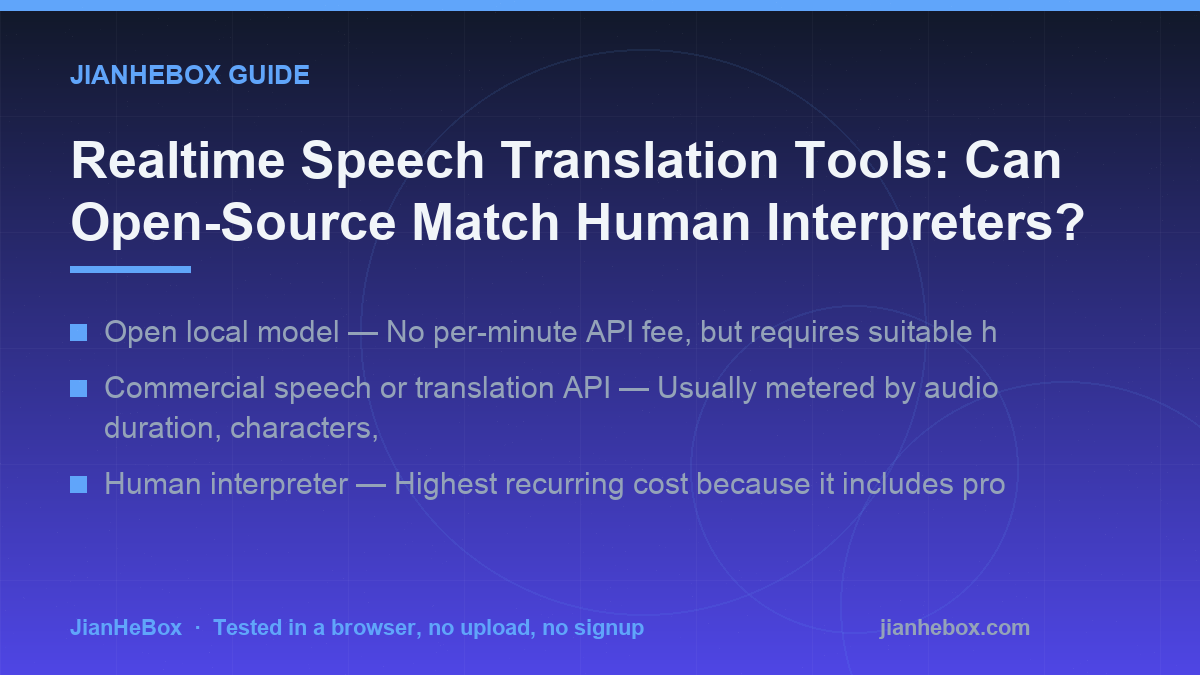
| Approach | Cost structure | Latency | Privacy | Accuracy and practical limits |
|---|---|---|---|---|
| Open local model | No per-minute API fee, but requires suitable hardware, setup time, maintenance, and power consumption. | Potentially near-real-time on adequate hardware. Hy-SimulMT is reported at roughly 3 seconds end to end under its tested conditions; actual performance depends on the deployment. | Strongest option when audio and transcripts remain on the user’s machine or private infrastructure. | Can provide consistent Chinese-English translation and cloned voice output. Results still vary with audio quality, terminology, accents, context, and voice configuration. |
| Commercial speech or translation API | Usually metered by audio duration, characters, or a combination. Pricing and service limits vary by provider. | Often convenient because the provider manages infrastructure, but network round trips, buffering, and service queues add variability. | Privacy depends on the provider’s data policy, retention settings, contract, and region of processing. | Managed APIs may be easier to integrate and scale. Quality should be tested against the exact language pair, domain, and voice requirements. |
| Human interpreter | Highest recurring cost because it includes professional availability and human working time. | A human interpreter often needs a 2–5 second reaction window; longer passages still create accumulated delay. | Can be managed through confidentiality agreements and controlled channels, but conversation may still be shared with a service provider. | Strongest option for ambiguous, high-stakes, culturally sensitive, or legally consequential conversations. Human fatigue and speaker overlap can affect performance. |
This comparison applies most directly to speech-to-speech translation. Captioning systems that produce text can feel faster because users read ahead, while systems that only provide a transcript or translation must be evaluated separately. Latency claims should also identify whether measurement includes speech recognition, translation, synthesis, network transfer, and playback.
Hy-SimulMT-30B-A3B: what the open model does
Architecture and translation mode
Hy-SimulMT-30B-A3B is a mixture-of-experts, or MoE, speech-to-speech translation model. In an MoE architecture, a router sends each token through a selected subset of specialized expert layers rather than activating the entire model for every token. The “30B-A3B” designation refers to a 30-billion-parameter model with an approximately 3-billion active-parameter path, according to the model naming convention. The official repository should be consulted for the exact configuration and supported runtime implementations.
Unlike a conventional pipeline that separately performs automatic speech recognition, machine translation, and text-to-speech, Hy-SimulMT is designed around a more integrated, interleaved speech workflow. Its target language pair is bidirectional Chinese-English translation: a Chinese speaker can receive an English vocal translation, and an English speaker can receive a Chinese one.
This design is especially relevant to simultaneous interpretation because it aims to preserve the turn-taking experience of a conversation. A text-first pipeline can introduce separate delays at recognition, translation, and synthesis stages. A unified speech model can process those functions within one system, although deployment speed still depends on hardware, quantization, audio framing, and the selected serving stack.
Reported latency and independent comparison
The reported roughly 3-second end-to-end latency should be understood as a headline deployment result, not a guarantee for every machine and every sentence. A noisy room, long utterance, CPU offload, or software fallback can change response time.
Chinese technology media also reported that Hy-SimulMT outperformed mainstream commercial APIs in simultaneous-interpretation tests. That is a meaningful signal for buyers evaluating the model, but media test conditions are not automatically equivalent to a controlled, reproducible benchmark. Before selecting a vendor or model, users should run their own test set containing the voices, accents, technical vocabulary, and interruptions they actually expect.
FP8 weights and official distribution
Official FP8-quantized weights are distributed under the name Tencent-Hunyuan/Hy-SimulMT-30B-A3B-Interleave-FP8 on Hugging Face, ModelScope, and GitHub. FP8 uses eight-bit floating-point representations to reduce weight storage and memory requirements relative to higher-precision formats. The exact supported accelerators, kernels, and inference frameworks should be checked in the official repository.
For search and discovery purposes, the relevant identifiers are:
- Model: Tencent Hunyuan Hy-SimulMT-30B-A3B
- Official weight variant: Hy-SimulMT-30B-A3B-Interleave-FP8
- Official application: Hy Translate for Android and iOS
- Primary capabilities: realtime Chinese-English speech-to-speech translation and supported voice-cloning workflow
The official Hy Translate app gives users a low-friction way to evaluate the model before planning a local deployment. Feature availability in the app may evolve, so the official repository and app release notes remain the authoritative sources for current functionality.
Hardware requirements for a 30B-A3B MoE
The A3B designation lowers the amount of computation active for each token, but it does not mean that only 3B parameters must be stored. All 30B parameters must still be loaded unless the implementation supports expert offloading. At approximately one byte per weight for FP8, the weights alone represent roughly 30 GB before runtime metadata, activations, caches, audio buffers, and framework overhead.
That arithmetic provides a useful planning rule: a 24 GB GPU should not be assumed sufficient for a fully resident FP8 deployment. Operators should expect to consider a larger-memory accelerator, multiple GPUs, or a unified-memory system with sufficient capacity. CPU-only or partially offloaded execution may be possible, but its latency and throughput should be measured rather than inferred from the model’s published result. Check the official repo for tested hardware, exact VRAM figures, and compatible inference engines.
How voice cloning is connected
Hy-SimulMT’s realtime voice-cloning support requires a configured TTS service. The translation model handles the speech-to-speech translation workflow, while the connected TTS service supplies voice cloning or speech rendering according to the integration documented in the repository. Users should not interpret this as a standalone cloning model that can replace every TTS component.
A practical deployment therefore has three logical parts:
- Audio capture and speech processing.
- Hy-SimulMT producing the translated interleaved speech representation or output.
- A configured TTS service converting the appropriate voice instruction or audio into a cloned voice.
The precise signal format and wiring are implementation details; consult the official repository rather than assuming compatibility with any arbitrary TTS engine.
The local voice toolchain: IndexTTS2, Qwen3-TTS, CosyVoice3, and VoxCPM2
Open speech translation does not have to end at translated text. A local toolchain can preserve a recognizable speaker identity and control delivery characteristics.
IndexTTS2
IndexTTS2 adds native MLX zero-shot voice cloning along with controls for emotion, speed, and pauses. Zero-shot cloning means generating speech in a target voice from a reference sample without training a separate model for that speaker. For Mac users, MLX is particularly relevant because it is optimized for Apple’s unified-memory environment.
IndexTTS2 also works with speaker encoders from Qwen3-TTS and CosyVoice3. In this ecosystem, those components can help represent or transfer speaker characteristics, while IndexTTS2 provides the synthesis and control layer. Their exact interchange workflow and supported checkpoints should be confirmed in each project’s documentation.
Qwen3-TTS and CosyVoice3
Qwen3-TTS and CosyVoice3 are relevant when a deployment needs speaker-reference or speaker-encoder functionality. Their role is not limited to generating ordinary speech. They can provide voice identities that feed into a broader synthesis workflow, including the IndexTTS2 ecosystem.
For a translator evaluating cloned voices, the distinction matters. A speech-translation model can produce the translated utterance, but voice identity, emotional delivery, and pause behavior often depend on the TTS stage. Comparing only the translation model will not reveal the full quality of the final audio.
VoxCPM2
VoxCPM2 supports local voice cloning on Mac through MLX at 48 kHz. It is a practical choice for users who want high-resolution locally generated speech without sending reference audio to a hosted service. It complements Hy-SimulMT by handling voice generation, while Hy-SimulMT handles real-time Chinese-English translation.
A Mac-based setup can therefore combine a local translation model, a zero-shot cloning component, and MLX-accelerated synthesis. The memory and latency of that complete pipeline matter more than the benchmarks for any single component, so test the assembled system.
What the Soniqo benchmark measures
Soniqo, published on July 2, 2026, provides a useful reference protocol for voice-cloning evaluation. It cloned ten FLEURS reference speakers across five languages and generated ten held-out sentences for each speaker.
Its evaluation averaged:
- Speaker similarity.
- Word error rate or character error rate, abbreviated WER/CER.
- Predicted UTMOS quality.
- Steady-state speed.
These dimensions prevent “voice quality” from becoming a vague claim. Speaker similarity measures whether the clone resembles the reference voice, while WER/CER checks intelligibility and transcription accuracy. UTMOS provides a predicted perceptual-quality measure, and steady-state speed reflects throughput after startup effects. The supplied benchmark reference does not, by itself, establish that Hy-SimulMT wins every comparison; each candidate should be tested under the same protocol.
Where realtime speech translation is most useful
Online meetings
Realtime translation is most valuable in meetings when participants need to continue speaking naturally rather than wait for formal interpretation. Hy-SimulMT’s reported three-second latency can support short conversational exchanges, especially when the system is tested with similarly short turns.
For production meetings, administrators should test overlapping speech, long technical sentences, crosstalk, and microphone placement. They should also decide whether translation is spoken through headphones, shared speakers, or personal devices. Shared playback can improve access but may expose translated content to the room; personal devices improve privacy but require more synchronization.
Live-stream captions and audience translation
For live streams, text captions can be easier to consume because viewers read at their own speed. Speech-to-speech translation adds value when the target audience needs an audible translated track, such as international livestreams, tourism broadcasts, or multilingual community programming.
The pipeline should account for stream delay, moderation, and transcript quality. A model that sounds good in a quiet demonstration may struggle with music, alerts, names, or fast speech. Teams should preserve a caption fallback and compare caption latency with spoken output rather than treating the two as identical products.
Overseas support desks
Overseas support desks can use bidirectional translation to reduce the friction of customer conversations while keeping a human agent in control. In this scenario, the system should not silently replace the agent. Instead, it should provide a low-latency translation channel, log only what policy permits, and make escalation to a human interpreter easy.
Support-specific vocabulary, product names, addresses, numbers, and customer emotional cues should be included in the acceptance test. Accent variation is especially important because an international customer base may include many English or Chinese accents not represented in a general demonstration.
Why sensitive meetings favor local translation
Local deployment is often preferred for confidential meetings because audio, prompts, translated output, and voice references can remain on the organization’s own hardware or private infrastructure. This reduces the number of external parties receiving conversation data and can help organizations enforce retention and access rules.
Local operation does not automatically make a system private. Operators still need to secure model files, disable unwanted telemetry, protect temporary audio files, restrict logs, and control whether references or outputs leave the device. MLX-based components such as IndexTTS2 and VoxCPM2 make it easier to keep cloning and synthesis local on a Mac, but the full translation path must also remain local.
For legal, medical, HR, board, or customer-sensitive conversations, the privacy review should cover:
- Where audio is processed.
- Whether requests or outputs are retained.
- Who can access the voice reference.
- Whether a commercial API fallback exists.
- How consent is obtained for cloning a speaker’s voice.
Voice cloning also requires explicit consent. A familiar voice can amplify the impact of impersonation or misuse, even when the underlying translation is accurate.
Recommended rollout path: cloud trial, local deployment, then hardening
1. Run a controlled cloud API trial
Begin with a limited trial using representative audio, not a polished demo. Include short and long sentences, two accents, background noise, overlapping speakers, and organization-specific terms. Record end-to-end latency rather than just model-processing time.
Compare more than one commercial API if the application is business-critical. The objective is to establish acceptable quality and a baseline for latency, not to identify a permanent vendor immediately.
2. Deploy the open model locally
Use the official FP8 weights and a serving configuration supported by the repository. Benchmark the model on intended hardware, then test the complete speech path with the selected TTS and cloning service.
Measure warm-start time, steady-state latency, peak memory, throughput, and behavior when several sessions run concurrently. On Mac, test the relevant MLX components together. On GPU infrastructure, verify that the FP8 kernels and MoE routing are supported by the installed runtime.
3. Harden the production system
Production hardening should include:
- Automatic fallback when the model, TTS service, or network fails.
- Audio buffering and backpressure policies.
- Session isolation and access controls.
- Monitoring for latency, transcription errors, crashes, and voice-synthesis failures.
- A human escalation path for disputed or high-stakes exchanges.
- Retention rules for recordings, transcripts, logs, and voice references.
- Documented consent and restrictions for voice cloning.
The official Hy Translate app for Android and iOS can also support user trials, but it should not substitute for testing the exact local integration that will enter production.
Frequently asked questions
What does 3-second speech-to-speech latency mean?
It means the system can begin playing an approximately three-second translated audio response after receiving speech. It does not guarantee that every utterance is translated in exactly three seconds, nor does it measure a text-only caption system. Sentence length, hardware, network conditions, and TTS performance can change the result.
How does a 3-second translation latency compare with a human interpreter?
A human interpreter often has a 2–5 second reaction window before starting an interpretation. The automated system’s reported three-second figure is therefore in a comparable conversational range, but it should not be treated as a blanket quality judgment. Humans can reinterpret context, clarify ambiguity, and adapt in real time; automation can provide consistent availability and scale.
Can Hy-SimulMT clone a voice by itself?
Hy-SimulMT supports a realtime voice-cloning workflow when a TTS service is configured. The connected service handles the voice-cloning or synthesis stage. Teams should follow the official repository for supported services, reference formats, and deployment wiring rather than assuming that every TTS model is interchangeable.
Is the open model cheaper than a commercial translation API?
It can be cheaper at sustained or sensitive workloads because there is no per-minute API charge, but it is not free to operate. Hardware, power, setup, upgrades, monitoring, and engineering time all count. A commercial API may be cheaper for low-volume trials, while a local model can become more economical once utilization is high enough to justify the infrastructure.
Which local tools should Mac users choose?
For voice cloning and synthesis on Apple hardware, MLX is the key ecosystem to investigate. IndexTTS2 provides native MLX zero-shot cloning with emotion, speed, and pause controls, while VoxCPM2 supports local Mac voice cloning through MLX at 48 kHz. Qwen3-TTS and CosyVoice3 speaker encoders can also participate in IndexTTS2-compatible workflows. Check each official repository for current support.
How should users compare realtime translation quality?
Use the same audio and scoring process for every candidate. Measure end-to-end latency, transcription accuracy through WER or CER, translation quality, speaker similarity, perceived audio quality, and steady-state speed. The Soniqo protocol provides a useful reference because it combines ten FLEURS reference speakers, five languages, ten held-out sentences per speaker, and several objective quality measures. Add domain-specific tests before making a purchasing decision.
Data verified November 2, 2026. Model capabilities per official repos.
Data verified November 2, 2026. Pricing, quotas, and features are per official platform pages.