Tsinghua's Algebraic World Model (AWM): Teaching AI to Find Laws Like Newton
Yao Qizhi and Yuan Yang’s team released the Algebraic World Model, an approach that turns interaction with unfamiliar environments into executable mathematical models. The important part is not merely that the AI produces an answer, but that it builds a model that can be run, tested, and revised.
The Problem: An Answer Is Not Yet a Law
Imagine an engineering team facing an unfamiliar environment whose operating rules are not documented. Researchers can interact with it and record what happens, but the governing relationships remain hidden. A conventional language model can summarize those interactions in polished prose. The Algebraic World Model, or AWM, takes a different route: it explores the environment, expresses candidate explanations as executable Python hypotheses, and keeps testing them.
This distinction matters because a fluent explanation can sound authoritative without identifying a working rule. An executable hypothesis is harder to dismiss. If it fails when run against the environment, the team has evidence to reject it. If it survives repeated testing, the model becomes a more defensible account of the environment rather than merely a plausible paragraph.
AWM’s central contribution is therefore methodological. It gives an AI a Newton-inspired task: reconstruct scientific laws through algebraic reasoning instead of retrieving correlations from massive text and presenting them as an answer. The release should still be evaluated on evidence rather than metaphor, but the workflow is concrete enough to inspect.
What Tsinghua Released
On November 1, 2026, a team led by Tsinghua’s Yao Qizhi and Yuan Yang released the Algebraic World Model. The associated paper is titled “Algebraic World Model: From Exploration to Proofs”. It was submitted to arXiv on October 30, 2026, with the identifier arXiv 2610.40503 and the categories cs.AI and cs.LO.
The release also came on the same day as DeepSeek’s Super Agent architecture. That timing provides context for the interest around agents that act on environments rather than operate only as text generators. It does not, by itself, establish a technical comparison between the two systems: the available release details do not describe shared components, equivalent benchmarks, or equivalent capabilities.
How AWM Builds a Model
The method can be understood as a continuous cycle rather than a one-shot prompt. The system does not begin with a finished explanation. It begins with an environment, develops a mathematical hypothesis, turns that hypothesis into code, and uses test results to decide what should happen next.
1. Explore the environment
The first step is exploration. AWM is designed for situations in which the relevant rules are not already supplied in a convenient textual form. Interaction with the environment supplies the material from which a model must be reconstructed. The goal is not to collect disconnected observations, but to use those interactions to identify relationships worth formalizing.
This is a meaningful change in emphasis from conventional language-model use. Instead of asking a model to draw on patterns learned from massive text and return the most likely explanation, AWM asks what candidate rule would account for the environment it is actually exploring.
2. Develop executable Python hypotheses
Candidate explanations are expressed as Python code. Making a hypothesis executable is the practical bridge between an abstract idea and an empirical claim. A sentence such as “the relationship may follow a particular algebraic rule” can remain ambiguous. Its Python representation can be run, compared with observed behavior, and corrected when the result does not hold.
Code also gives reviewers a concrete object to inspect. They can examine the stated relationship, run it, and determine whether the implementation matches the proposed hypothesis. The release description does not specify a particular coding style, library set, or software architecture, so the important principle is executable hypothesis formation rather than any undocumented implementation detail.
3. Test continuously
AWM repeatedly tests its hypotheses against the environment. A test result is not a ceremonial final step; it is the feedback that drives the next revision. A candidate that does not account for the observed behavior must be changed, rejected, or replaced with a better explanation.
This hypothesize-and-test loop is the clearest operational difference from a conventional LLM workflow. The emphasis moves from producing a response because it fits textual correlations to producing a model because it survives contact with the environment. Testing also creates a record of why the current model exists, which is considerably more useful than an answer that appears without visible validation.
4. Maintain an explicit mathematical model
The outcome is an explicit mathematical model that supports formal reasoning. The model is not locked inside an unstructured answer. It can be examined as a set of relationships, executed through the associated hypotheses, and revised when new test evidence conflicts with it.
That explicitness changes collaboration. A researcher can challenge an equation, a developer can inspect a Python hypothesis, and a domain expert can focus on the relationship being modeled rather than debating the tone or wording of a generated response.
5. Work under restricted historical knowledge
The stated goal is to reconstruct scientific laws through algebraic reasoning under clean, restricted historical knowledge. This condition is part of the experimental premise, not an incidental detail. It distinguishes the exercise from simply asking a broadly trained model to reproduce a familiar answer already present in its textual knowledge.
- Explore an unfamiliar environment rather than assuming its law is already written down.
- Turn candidate explanations into executable Python hypotheses.
- Test those hypotheses and revise them when the evidence disagrees.
- Maintain the result as an explicit mathematical model suitable for formal reasoning.
How AWM Differs from a Conventional LLM
The release draws a useful contrast. A conventional LLM is described here through its dependence on correlations fitted from massive text. AWM instead runs an explicit hypothesize-and-test loop against an environment. The distinction concerns the source of evidence, the working process, and the form of the result.
| Dimension | Conventional LLM approach | Algebraic World Model |
|---|---|---|
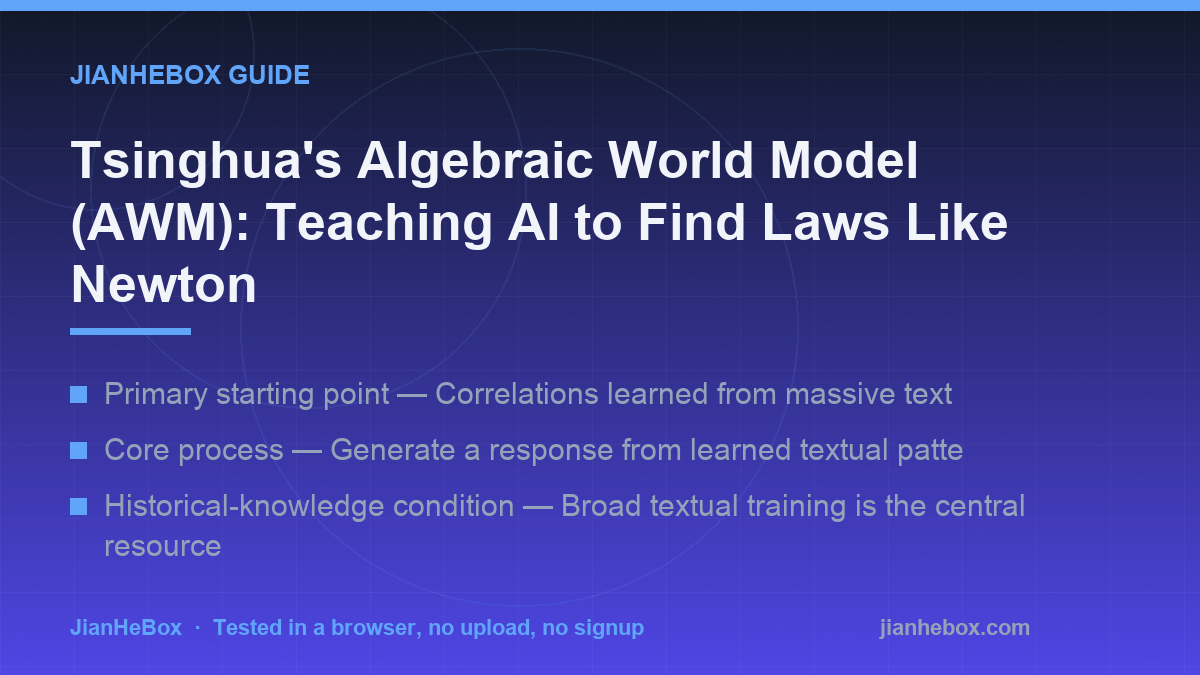
| Primary starting point | Correlations learned from massive text | Interaction with an unfamiliar environment |
| Core process | Generate a response from learned textual patterns | Explore, hypothesize, execute, test, and revise |
| Historical-knowledge condition | Broad textual training is the central resource | Clean, restricted historical knowledge frames the reconstruction task |
| Working artifact | A generated textual response | An executable Python hypothesis and an explicit mathematical model |
| Validation emphasis | Quality and usefulness of the response | Whether hypotheses survive testing against the environment |
| Desired outcome | An answer that fits the prompt | A law-like model reconstructed through algebraic reasoning |
This is not merely a stylistic difference. Text-based generation can produce an excellent summary of how a known system usually behaves. AWM is aimed at a harder and more specific problem: determining how an unfamiliar system behaves by testing candidate rules. The environment becomes part of the computation, not merely the subject of a description.
It would be a mistake, however, to infer from this contrast that conventional LLMs cannot write code or that AWM contains no language model. The release details establish the methodological contrast, not a complete component inventory. The defensible claim is narrower: AWM organizes its work around an explicit hypothesize-and-test cycle rather than around correlation-fitting alone.
Why “Letting AI Think Like Newton” Is Useful
The Newton framing is best understood as shorthand for a scientific method, not as a claim about machine consciousness or literary genius. Newton’s name evokes the move from observed phenomena to compact laws that can be stated, applied, and checked. AWM applies the same practical logic in software: express a relationship, execute it, compare its behavior with the environment, and revise it when necessary.
Algebraic reasoning adds another layer. The system is encouraged to work with explicit relationships rather than only impressions. “This seems to happen often” is weak evidence for a law-like model. A mathematical hypothesis states what should happen, while an executable test shows whether it actually happens. The distinction makes the discovery process falsifiable at the level of each candidate relationship.
The restricted historical-knowledge condition strengthens the intent of the exercise. If the goal is to observe law reconstruction rather than recall, the system should not rely on a familiar formulation already dominating its training material. In practical terms, “thinking like Newton” means turning evidence into a compact, testable rule and treating the rule as provisional until the environment supports it.
Practical Significance
AWM’s most important implication is methodological. It suggests that capable agents need an interface between language and mathematical verification. Natural language is good for stating questions, describing evidence, and communicating candidate ideas. Python is good for making those ideas concrete. Formal reasoning supplies a way to examine the resulting model. A workflow that combines all three is more defensible than one that asks a language model to collapse every stage into a single response.
The approach is also valuable wherever the task is discovery through interaction rather than retrieval from a corpus. If the desired result is a relationship that explains an unfamiliar environment, executable hypotheses create a practical audit trail. The team can see which assumptions were tried, which survived testing, and which had to change. That is a better foundation for scientific work than a polished conclusion whose derivation cannot be reconstructed.
There are limits to what the announcement establishes. The available release details do not include benchmark results, a task list, performance measurements, or a code-distribution plan. Without those results, readers cannot yet judge how broadly the method works, how expensive exploration becomes, or how often the generated hypotheses transfer from toy settings to demanding environments. The method is compelling; the evidence needed for a deployment decision remains the next question.
Hands-On Selection Guide
Choose the approach according to the source of truth and the artifact you need. If the evidence already exists primarily in text and the desired result is language, a conventional LLM is the more natural tool. If the rules must be discovered by interacting with an unfamiliar environment, AWM’s structure is the stronger fit. The table makes that practical distinction explicit.
| Your primary need | Better starting point | Reason |
|---|---|---|
| Summarize or synthesize a large textual corpus | Conventional LLM | Its core advantage in this comparison is fitting correlations from massive text |
| Discover an unfamiliar environment’s operating rule | AWM | The method explicitly explores the environment and develops testable hypotheses |
| Produce an inspectable mathematical artifact | AWM | Its intended output is an explicit model supported by executable Python hypotheses |
| Retrieve and explain a well-documented scientific law | Conventional LLM, with independent checking | The task is centered on known text rather than reconstruction through environment interaction |
| Combine textual background with environment discovery | Hybrid workflow | Use a conventional LLM for broad language work and AWM’s loop for executable model construction |
| Make a production decision from the release announcement alone | Wait for comparative evidence | The available details do not report benchmarks or performance results |
For an evaluation, give both approaches the same environment and the same task description. Ask the conventional LLM for an explanation, then ask the AWM workflow for an explicit model with executable hypotheses. Compare more than the final prose: inspect the proposed relationships, run the code, record failed tests, and check whether revisions lead to a model that consistently accounts for the environment.
Do not hide the AWM process inside a polished summary, either. Its value is the sequence of exploration, hypothesis, test, and revision. If you flatten that sequence into a final answer, you lose the evidence that distinguishes AWM from ordinary model-assisted explanation.
Common Pitfalls
- Equating executable code with proof. A Python hypothesis can show that a proposed relationship runs and can be rejected by a failed test. The paper title refers to proofs, and AWM supports formal reasoning, but passing an empirical test should not automatically be presented as a theorem unless a separate formal argument has been supplied.
- Treating code generation as validation. Producing syntactically valid Python proves only that an idea can be executed. The test must address the environment and provide evidence for accepting or rejecting the underlying hypothesis.
- Ignoring the history condition. If the objective is to measure law reconstruction, broad textual recall can blur the result. Keep the historical knowledge clean and restricted when evaluating whether exploration and algebraic reasoning produced the model.
- Keeping only the final answer. A final model without its rejected hypotheses and test outcomes conceals the most useful part of the workflow. Preserve the path from exploration to revision.
- Reading too much into the release date or Newton metaphor. Same-day timing with DeepSeek’s Super Agent architecture is interesting context, not a benchmark comparison. Likewise, “thinking like Newton” describes the scientific posture, not machine consciousness or proven human-like reasoning.
Frequently Asked Questions
What is Tsinghua’s Algebraic World Model?
The Algebraic World Model, or AWM, is a method for turning interaction with an unfamiliar environment into an explicit mathematical model. A team led by Yao Qizhi and Yuan Yang released it on November 1, 2026. Its central procedure is to explore the environment, develop candidate explanations as executable Python hypotheses, test them, and revise the model. The intended result is a law-like representation that supports formal reasoning rather than an answer based only on correlations fitted from massive text.
How is AWM different from a conventional large language model?
A conventional LLM primarily relies on correlations learned from massive text when producing a response. AWM instead follows an explicit hypothesize-and-test loop. It interacts with an unfamiliar environment, turns candidate rules into runnable Python code, and uses test results to refine an explicit mathematical model. The distinction is therefore not simply “AI versus. AI.” It concerns the evidence used, the sequence of work, and whether the final artifact can be executed and checked against the environment.
What does an “executable Python hypothesis” mean?
An executable Python hypothesis is a proposed relationship written in a form that can be run rather than discussed only in prose. The code embodies the candidate rule, making it possible to compare its behavior with the environment. If the result conflicts with what the environment does, the hypothesis can be rejected or revised. The release does not specify a particular programming framework, syntax, or set of libraries, so the defining feature is the executable representation of the mathematical idea and its role in the testing loop.
Does AWM prove scientific laws automatically?
No automatic proof should be assumed from the release description alone. AWM is designed to reconstruct scientific laws through algebraic reasoning, and its paper is titled “Algebraic World Model: From Exploration to Proofs.” The method can create explicit models and support formal reasoning, while repeated tests can provide evidence for a candidate relationship. However, an executable hypothesis that passes a test is still distinct from a formal theorem unless the proof requirements have been established and independently checked.
Why does the release describe AWM as “letting AI think like Newton”?
The phrase refers to the progression from observation to a compact, testable law. In AWM, the system explores an environment, proposes an algebraic relationship, executes it, and tests what happens. That resembles the practical scientific posture associated with Newton: derive a rule, apply it, and confront it with evidence. The comparison is metaphorical rather than a claim that the system thinks like a human. It highlights disciplined hypothesis formation, explicit modeling, and revision in response to observation.
What is known about the paper, code, benchmarks, and comparison with DeepSeek?
The paper is available under arXiv identifier 2610.40503. It was submitted on October 30, 2026, categorized under cs.AI and cs.LO, and released with AWM on November 1, 2026. The available release details do not report benchmark results, task suites, performance numbers, or a code-distribution plan. AWM was released on the same day as DeepSeek’s Super Agent architecture, but no direct technical or experimental comparison is provided, so the two should not be ranked from release timing alone.
Concrete Recommendation
Evaluate AWM as a disciplined model-building workflow, not as a ready-made replacement for every LLM application. Start with one unfamiliar environment, define what evidence the model must explain, require every candidate relationship to appear as executable Python, and preserve both successful and failed tests. Compare that process with a conventional LLM given the same task, using model correctness, testability, and revision quality as the decision criteria. If the environment contains the unknown and the deliverable is an inspectable law-like model, AWM is the more relevant starting point. If the task is primarily textual recall or synthesis, keep a conventional LLM in the workflow.
More on this:Free Browser Based
Data verified November 3, 2026. Pricing, quotas, and features are per official platform pages.