Beijing's AI Literacy Framework for K-12: What the Three Tiers Actually Cover
Beijing’s new AI-education package is easy to misread as a promise to put conversational chatbots in every classroom. In reality, the two documents released together by the Beijing Municipal Education Commission in March 2025 form a much broader framework. The first defines what students should know, do, and ethically question; the second turns that framework into a progression for elementary, junior-secondary, and senior-secondary education. Its three domains—understanding AI, collaborating and creating with AI, and governing AI—are reinforced by three developmental levels: Foundation, Integration, and Excellence. This article examines the nine competency strands inside those domains, explains what changes as students progress, and translates the guidance into practical choices for teachers and parents. The central point is simple: AI literacy is not the ability to write clever prompts. It is the ability to understand data and models, work responsibly with machines, evaluate generated output, protect people from harm, and participate in decisions about how AI is used.
1. The Two Documents and the Nine Competency Strands
The formal source titles are 《北京市中小学生人工智能素养框架》—the Beijing Primary and Secondary School Students’ AI Literacy Framework—and 《北京市中小学人工智能通识课课程教学指导手册》—the Guidance Manual for Teaching AI General-Education Courses in Beijing Primary and Secondary Schools. The first is a competency architecture; the second is an instructional guide. They should therefore be read together: the framework says what progression should look like, while the manual addresses curriculum content, elementary-to-high-school articulation, teaching suggestions, evaluation, and safety.
Neither document is a regulation with enforceable numbered articles. It would therefore be misleading to cite a supposed “Article 7” of the framework. The stable equivalent of a clause reference is a matrix coordinate: domain, subdomain, and tier. This article uses the editorial identifiers BAILF-2025-D1-S1/T1 and similar forms; they are navigation aids, not claimed official issuance numbers. A formal bibliography should retain the document’s Chinese title, the 2025 release year, and the relevant PDF page or matrix row.
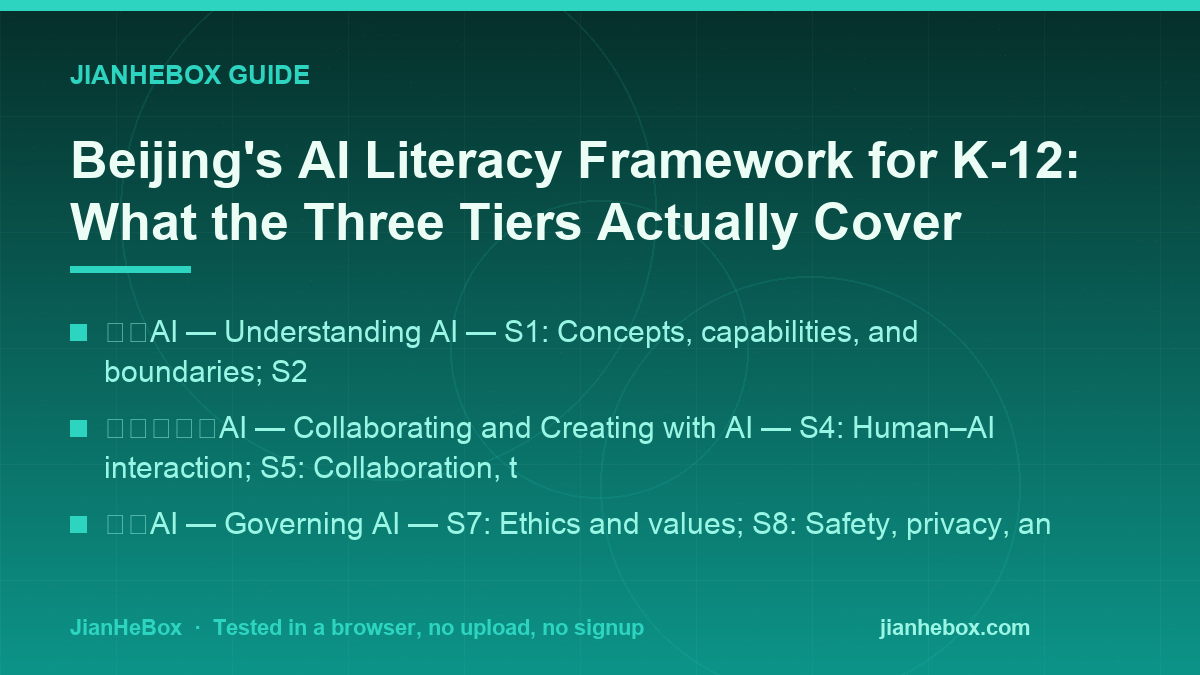
The framework contains nine strands, grouped into three domains of three. The following English names are functional translations of the matrix rather than an official one-to-one English glossary.
| Framework domain | Nine strands and reference coordinates | What the domain actually covers |
|---|---|---|
| 认知AI — Understanding AI | S1: Concepts, capabilities, and boundaries; S2: Data, models, and working mechanisms; S3: Application, interpretation, and evaluation | Knowing what AI is, distinguishing learning systems from ordinary automation, understanding that outputs depend on data and objectives, and selecting or evaluating AI tools rather than accepting their answers automatically |
| 协同与创设AI — Collaborating and Creating with AI | S4: Human–AI interaction; S5: Collaboration, task division, and workflows; S6: AI-enabled design, creation, and innovation | Communicating requirements to an AI system, dividing work sensibly between people and tools, testing generated artifacts, and designing useful solutions without treating automation as creativity by itself |
| 治理AI — Governing AI | S7: Ethics and values; S8: Safety, privacy, and security; S9: Law, accountability, and social governance | Reasoning about fairness, bias, harm, confidentiality, copyright, responsibility, and the social institutions that control AI deployment—not merely memorizing a list of safety rules |
These boundaries matter technically. Understanding AI is about explanatory competence: a student should be able to say that a recommendation system estimates likely preferences from examples and behavioral data, that its prediction is not a fact, and that its performance depends on the quality and representativeness of those examples. Collaborating and creating is about workflow design. A student should know when to delegate a summarization task, when a human judgment is indispensable, how to revise an output, and how to document what the model contributed. Governing AI is about responsible agency. Students should be able to identify stakeholders, ask who bears the risk of an error, distinguish legal compliance from ethical acceptability, and recognize when an automated decision should be challenged.
The framework’s strongest design decision is that governance is not placed after technical learning as an optional ethics lesson. It cuts across all nine strands. A primary student using a story-generating tool and a senior student designing a decision-support system both need to consider misuse, privacy, reliability, and attribution. The sophistication changes with age, but the responsibility does not disappear.
A useful implementation rule follows: every learning objective should name at least one technical concept, one observable action, and one governance implication. “Use an AI chatbot” is too vague. “Compare two generated explanations, identify one unsupported claim, and write why human verification is required” is assessable and technically meaningful.
2. Foundation, Integration, and Excellence Are Different from Grade Levels
The three tiers describe increasing sophistication, independence, and transfer. They should not be treated as labels for slow, average, and gifted students. They also should not be mapped mechanically onto elementary, junior-secondary, and senior-secondary school, because the manual deliberately uses a spiral curriculum. A younger student may be working at the Foundation level in one strand while beginning to demonstrate Integration-level behavior in another—for example, understanding basic data privacy while still needing scaffolding for source evaluation.
| Tier | Central capability | Observable evidence |
|---|---|---|
| 基础 — Foundation | Build reliable concepts and use AI safely with guidance | Explain core ideas in plain language, complete a bounded task with a teacher-provided workflow, recognize obvious errors or unsafe requests, and follow agreed rules |
| 融通 — Integration | Connect AI with other knowledge, tools, and people while independently evaluating results | Choose an appropriate method, combine AI output with subject knowledge, compare sources, revise and document work, and transfer a principle to an unfamiliar context |
| 卓越 — Excellence | Evaluate, design, and critically govern AI-enabled systems | Analyze model and data limitations, design a human-in-the-loop workflow, test for bias or failure modes, justify governance choices, and create an original solution to a real problem |
“Foundation” is not simply knowing less about software. It means possessing the stable conceptual base needed for safe, purposeful use. At this level, instruction should make abstract mechanisms concrete: compare a conventional rule-based program with a system that learns patterns from examples; identify which household devices use narrow machine learning; or ask a generative tool to explain its answer and then verify it against a textbook. Excessive prompting drills would be a poor substitute for this conceptual grounding.
“Integration,” or 融通, is sometimes mistranslated as “intermediate.” Its key idea is connection. Students should be able to bring AI into language, mathematics, science, arts, or civic education while maintaining disciplinary standards. A geography class might ask students to use an AI tool to compare urban plans, then require source-based verification and discussion of representational bias. A mathematics class might ask students to identify why an AI-generated solution makes a plausible but invalid inference. A language class might compare AI drafts with student writing to analyze voice, evidence, and revision.
“Excellence” should not mean unrestricted access to the most expensive model or the most advanced programming language. It means independent reasoning about systems and their consequences. At senior-secondary level, this can include examining dataset shift, hallucination, privacy leakage, automation bias, and the difference between an attractive demo and a reliable deployment. Students might design an AI-supported recommendation or classification workflow, specify human review points, test it on edge cases, and document why certain data should not be collected.
The most useful assessment strategy is therefore not to assign students permanently to a tier. Instead, teachers can use tiered versions of the same project. For example, a Foundation version might ask students to use a vetted tool, check three facts, and record one limitation. An Integration version might require tool selection, comparison with a second output, and a sourced recommendation. An Excellence version might require an original workflow, a failure-mode test, and a governance memo. The underlying competency remains visible while complexity and autonomy change.
3. How the Manual Builds an Elementary-to-High-School Progression
The Guidance Manual focuses on what it calls the connection and progression among school stages, staged teaching recommendations, evaluation, and safety assurance. Its most important pedagogical message is that AI education should be a spiral, not a sequence in which one year introduces a chatbot and another year introduces another vendor’s chatbot. Concepts should return in more demanding forms as students’ disciplinary knowledge and ethical agency grow.
| School stage | Recommended emphasis | Appropriate technical depth | Typical evidence of learning |
|---|---|---|---|
| Elementary | Encounter, recognize, and safely use AI in meaningful contexts | Concrete distinctions among human decisions, rule-based automation, and machine learning; basic prompting, source checking, and personal-information rules | A story, diagram, classification, or short explanation in which students identify AI contributions and one limitation |
| Junior-secondary | Explain mechanisms, combine AI with subject knowledge, and evaluate reliability | Data and labels, simple model logic, stochastic outputs, hallucination, copyright, bias, and structured prompting and verification | A cross-disciplinary project with source evidence, an iteration log, an error analysis, and a clear human decision |
| Senior-secondary | Analyze, design, evaluate, and govern AI systems | Statistical uncertainty, model limitations, fairness metrics, privacy threats, human oversight, and system-level trade-offs | A defensible prototype or policy proposal, evaluation against defined criteria, risk analysis, and an explanation of governance choices |
In elementary school, instruction should remain concrete and experiential. Children can sort examples into “AI” and “not AI,” compare two chatbot answers, or investigate why a translation tool handles an expression differently. The objective is not to teach linear algebra. It is to develop accurate intuitions about learning from examples, machine fallibility, and safe interaction.
By junior-secondary school, students should be able to articulate why two systems trained on similar data can behave differently. They should understand that a language model predicts likely token sequences rather than consulting an authoritative database. This provides a natural foundation for discussing hallucination, bias, and verification without presenting AI output as magical or uniformly unreliable.
Senior-secondary students can engage with more formal concepts: training and inference, representation, confidence, false positives and negatives, dataset shift, and accountability. They can also study governance at an institutional level—school policies, platform terms, privacy law, procurement, and the allocation of responsibility when an automated recommendation influences a real decision.
For teachers, the manual translates best into a unit plan with six components. First, identify the disciplinary learning goal; AI should support that goal rather than become the topic by itself. Second, run a short diagnostic to establish what students already believe about AI. Third, select one age-appropriate scenario. Fourth, define the human checkpoints, including verification and disclosure. Fifth, design a common rubric. Sixth, reserve class time for reflection on failures, bias, and uncertainty.
This approach also prevents unnecessary duplication. A primary lesson might classify generated images as evidence of what a model can do, whereas a high-school lesson might test those images for fabricated references, embedded metadata, bias, and misuse. Both involve generation, but they are not the same learning objective.
There is one caveat: “spiral curriculum” must not become “the same tool exercise every year.” The repeated element should be a durable concept—such as data quality, feedback loops, or accountability—not a particular commercial product. Schools should therefore maintain a concept map that records which AI ideas have been taught, at what depth, and with what evidence.
4. Evaluation, Safety, and the Parent–School Partnership
The manual’s emphasis on staged evaluation is important because an ordinary knowledge test cannot reveal much about AI collaboration. A student may know the terminology but be unable to detect a faulty output; another may obtain a polished artifact without understanding its origin. Evaluation should therefore combine four kinds of evidence: a short conceptual explanation, a process record, a product, and a reflective judgment about limitations and consequences.
A practical school rubric could allocate 25 percent to concepts, 30 percent to the quality and transparency of the process, 30 percent to the disciplinary artifact, and 15 percent to reflection and governance. Those percentages are a local implementation example, not an official Beijing weighting. The crucial feature is that a high-quality generated output cannot compensate for an unsupported claim, undisclosed fabrication, or careless handling of personal data.
Safety should be designed as a data-flow and decision-flow process, not added as a closing slide. The Personal Information Protection Law of the People’s Republic of China, adopted on August 20, 2021 and effective on November 1, 2021, is particularly relevant. Article 31 treats the personal information of children under 14 as sensitive information and requires parental or guardian consent plus special handling rules. Article 6 supports purpose limitation and data minimization. Schools should therefore avoid collecting names, faces, voice recordings, location histories, family details, grades, or health information unless a documented purpose, suitable safeguards, and valid consent exist. The Interim Measures for the Management of Generative AI Services, effective August 15, 2023, also place responsibilities on service providers; they do not transfer responsibility away from schools for the tools they select.
A minimum school safety checklist should include: an approved tool and account list; minimum-age and identity controls; teacher-managed accounts; clear rules on uploadable data; retention and deletion settings; content filtering; incident reporting; age-appropriate human review; and an offline alternative for every assignment. Students should also learn to label AI use in their work. A simple disclosure—tool, purpose, date, and what the student verified—is preferable to a vague claim that “AI helped.”
Parents can cooperate without trying to become the school’s AI administrator. At the beginning of each term, ask which tools are approved, who owns the student account, what data is retained, whether conversations are used for model training, how long data is deleted, and who responds to a safety incident. Establish a family agreement: no uploading of identifiable information without permission, no using AI for a prohibited assessment, disclosure of material assistance, and verification of important claims. Once per month, ask a student to demonstrate one AI-assisted task and explain the evidence, uncertainty, and revision decisions. Finally, avoid equating educational opportunity with subscription spending. A free, school-managed tool plus a well-designed task is generally more educationally useful than an expensive model used without a rubric.
Teachers, meanwhile, should avoid invisible AI use. If a teacher secretly consults a model to design a quiz, uses generated examples without review, or permits students to submit unlabeled machine-written work, the school is teaching the wrong governance lesson. Parents can reasonably ask how recommended uses compare with prohibited ones and how students are taught to challenge a confident but false answer.
The right model is shared accountability without indiscriminate surveillance. Parents provide context and reinforce ethical habits; teachers provide instruction, assessment, and controlled access; students practice judgment. The framework succeeds only if students remain active reasoners rather than passive recipients of machine output—or passive targets of automated systems.
FAQ
Q: Are the Foundation, Integration, and Excellence levels equivalent to elementary, junior-secondary, and senior-secondary grades?
No. The levels describe competence and independence, not school years. The manual uses a spiral progression, so the same concept can recur at different levels. A student might be at Foundation level in model evaluation while demonstrating Integration-level skill in discussing privacy. Teachers should use tiered versions of tasks to reveal growth rather than assigning students permanently to a category or using the labels for tracking.
Q: Does a student need advanced mathematics, programming, or access to a frontier model to reach the Excellence level?
No. Excellence is about rigorous thinking, not tool prestige. Students should understand relevant data and model limitations, design or evaluate systems, and justify governance decisions. Advanced mathematics or coding may deepen that understanding for some students, but neither replaces conceptual reasoning. A well-documented, carefully tested solution using a school-managed tool can demonstrate Excellence more convincingly than an impressive demonstration with an expensive model and little verification.
Q: How can parents help with AI homework without doing the work for their child?
Parents should ask questions rather than supply answers: What was your task? Which parts did the tool assist with? What evidence supports the result? Where might it be wrong? What did you change? A brief monthly demonstration is often more valuable than daily policing. Parents should also help enforce school rules, protect personal information, and require disclosure of AI use. The child should still make the disciplinary decisions, verify the output, and explain the reasoning.
Q: How should teachers assess AI literacy when students use different tools?
Use a common set of concepts and criteria rather than judging students by the features of one platform. Assess four things: understanding, process, product, and reflection. The rubric can require a source comparison, a record of revisions, identification of an error, and a statement of what was verified. Give students equal access to an approved baseline tool, then allow extensions or alternative tools. Do not let polished wording, paid-model access, or rapid generation count as learning by itself.
Q: What information should schools and families never place in a public AI chatbot?
Families should avoid uploading names, contact details, faces, voice recordings, location data, medical or family information, school identifiers, unpublished examination material, and other students’ work. Schools should not rely only on warnings: approved accounts, filtering, retention settings, and age-appropriate procurement are necessary controls. For students under 14, Beijing schools must also account for the special personal-information rules in Article 31 of China’s Personal Information Protection Law.
Q: Does the framework favor particular AI vendors or require schools to buy AI tools?
It should not. The competency strands are vendor-neutral because they concern transferable concepts such as data quality, reliability, collaboration, and accountability. No commercial platform should define the curriculum. Schools should evaluate tools against age requirements, data handling, accessibility, Chinese-language performance, safety controls, export and deletion options, and interoperability. An offline or non-generative alternative is also important so that access, cost, or model availability does not determine who can demonstrate advanced work.
Beijing’s framework is best understood as a progression from guided awareness to independent, technically informed creation and governance—not as a procurement list or a license to outsource thinking. Its long-term value will depend on whether schools preserve that distinction in lesson plans, assessments, and family communication. For teachers and parents who need to prepare documentary, audiovisual, or PDF course materials, JianHeBox provides browser-local AI subtitle conversion, audio denoise, video compression, and PDF tools, with files processed in the browser and never leaving the user’s device.
More on this:Free Browser Based
Data verified November 9, 2026. Policy details are per the Beijing Municipal Education Commission official site.