DeepSeek's Open-Source Super Agent Architecture (November 2026)
Imagine handing an AI system one sentence: “Research this topic, compare the available approaches, and prepare a recommendation for our team.” A conventional chat interface may return one response, leaving you to coordinate the research, comparison, and writing yourself. DeepSeek’s Super Agent architecture targets a different interaction: the agent breaks the request into manageable steps, carries the relevant context through those steps, and invokes tools when execution requires them.
That sounds like a small change in interface design. In practice, it moves the hardest engineering work into the agent itself. The system must decide what constitutes a useful subtask, what information should survive between subtasks, and how an intended action becomes a tool call. DeepSeek published its Super Agent architecture on November 1, 2026, giving developers an open reference for addressing exactly those problems.
What DeepSeek Published
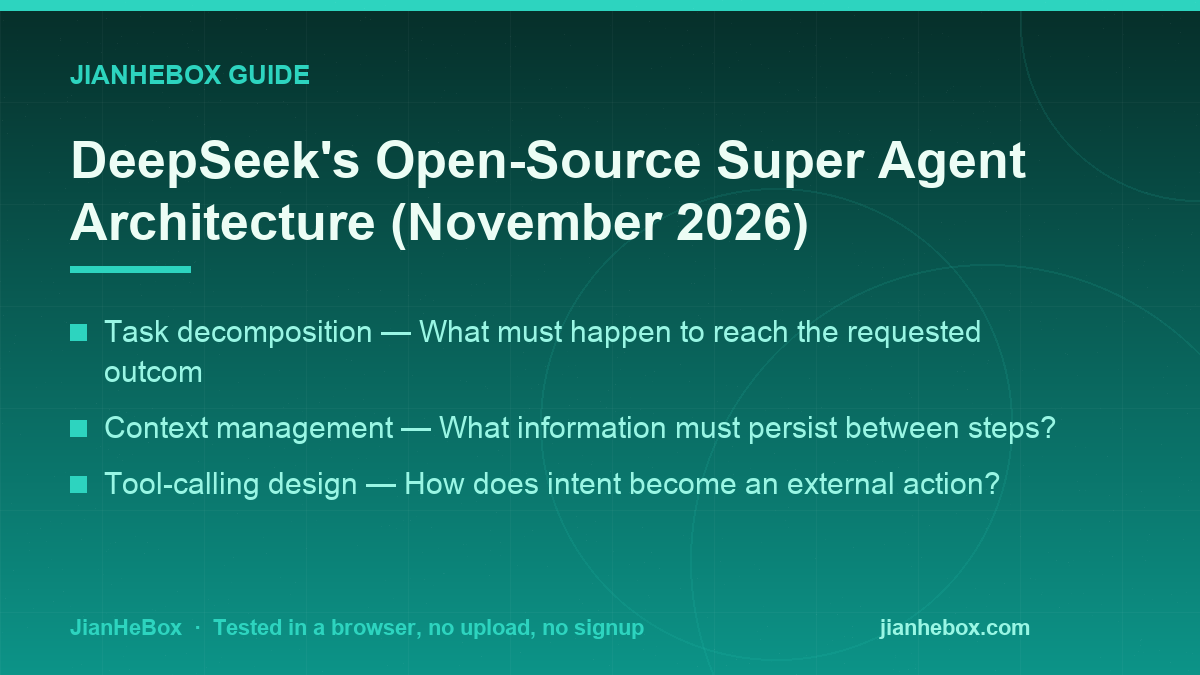
The November 1 release is an architecture for agent-style systems that plan and execute multi-step tasks. Its central concerns are task decomposition, context management, and tool-calling design. That combination is more useful to developers than a list of isolated capabilities because it describes how an agent moves from a broad request to a completed outcome.
For everyday users, the practical shift is that “hand one sentence to an agent and let it decompose the work” becomes the default interaction. For developers, the open architecture serves as a reference implementation, reducing the cost of building agents from scratch. You can study how another team framed the same coordination problems instead of inventing a planner, context strategy, and tool interface with no established baseline.
The November 2026 Open-Source Wave
DeepSeek’s publication did not occur in isolation. It was part of the same open-source wave as NVIDIA/MIT’s MiniMax H3 derivative on October 28 and Pika H3 Flex on October 29. On November 1, the same day as the Super Agent architecture, Tsinghua’s Yao Qizhi team released the Algebraic World Model, identified as arXiv 2610.40503.
The sequence is notable for developers watching agent infrastructure evolve alongside related open work:
- October 28: NVIDIA/MIT released its MiniMax H3 derivative.
- October 29: Pika released H3 Flex.
- November 1: DeepSeek published the Super Agent architecture, while Tsinghua’s Yao Qizhi team released the Algebraic World Model as arXiv 2610.40503.
These releases should not be treated as interchangeable implementations. The available facts establish their timing and place within the same open-source wave, but they do not provide a detailed technical comparison. Their practical significance is that agent architecture became a topic developers could inspect and reuse rather than something available only through closed product interfaces.
What the Announcement Does Not Claim
The supplied information does not specify a repository layout, runtime, license terms, supported programming language, hosted service, model configuration, or benchmark result. It is therefore safer to describe this as an open architecture and reference implementation, not as a turnkey platform with every deployment detail already resolved.
That boundary does not weaken the release. A reference architecture is most valuable when it makes design decisions visible. Even without adopting DeepSeek’s stack wholesale, developers can evaluate how planning, context, and tools are organized and decide which ideas belong in their own systems.
Architecture Breakdown: Three Connected Problems
The Super Agent architecture can be understood through three connected questions. Task decomposition determines what work must happen. Context management determines what the system needs to remember while it happens. Tool-calling design determines how the system acts when language alone is insufficient. A strong agent must answer all three consistently.
1. Task Decomposition: Turning a Goal into an Executable Plan
Task decomposition is the first architectural test because a broad request rarely arrives as a ready-to-execute instruction. “Prepare a recommendation” may require gathering information, identifying alternatives, comparing criteria, checking details, and assembling a deliverable. The agent must turn that outcome into a sequence that can be carried out rather than merely described.
A useful decomposition should make each subtask concrete enough to produce an observable result. It should also reveal dependencies. If one step cannot begin until another produces information, the plan must preserve that order. Otherwise, the agent may appear busy while producing disconnected fragments that never become the requested outcome.
There are several questions an implementer should ask of any decomposition strategy:
- Does every subtask contribute directly to the final deliverable?
- Can the result of each subtask be checked before the next step depends on it?
- Does the plan stop when the outcome is complete rather than continuing indefinitely?
- Can a failed step be retried without restarting the entire task?
- Does the decomposition remain understandable to the person who supplied the original request?
The one-sentence interaction works only if decomposition does more than split text into smaller prompts. The decomposition has to preserve intent. Each step should carry forward the constraints that still matter, discard details that no longer apply, and produce information needed by the remaining plan. Otherwise, the user saves typing but inherits a more complicated coordination problem.
2. Context Management: Carrying State Without Carrying Everything
The initial sentence is a statement of intent, not a complete working context. During execution, the agent may encounter intermediate results, tool responses, decisions, and unresolved details. Context management determines which of those belong in the next step and which do not.
Keeping too little context causes obvious failures. A later step may forget the target audience, ignore an earlier constraint, or repeat work already completed. Keeping too much creates a different problem: irrelevant material crowds out the details that matter, and important instructions become harder to distinguish from background noise.
For implementation purposes, context should be treated as a set of roles rather than an undifferentiated transcript. The agent needs to distinguish the original goal, active constraints, current plan state, results already established, tool output relevant to the next action, and unresolved questions. A reference architecture helps because it forces these roles into the design discussion before they become accidental behavior in a prompt.
Context management also connects planning and tool use. Decomposition says which step should happen next. Context says what that step is allowed to know. Tool-calling design says how that step reaches the outside world. When those concerns are separated, each one tends to be implemented in isolation. When they are connected, the agent can update its plan based on what actually happened rather than following a script that no longer matches reality.
3. Tool-Calling Design: Turning Intent into Action
Some subtasks are completed by generating text. Others require access to a specialized capability. Tool-calling design is the bridge between an agent’s intent and an external action. If that bridge is vague, the agent can know what it wants to accomplish yet still fail to request the right operation or use the result correctly.
A practical tool interface should answer several questions:
- What action does the tool perform?
- What input does it require?
- What result will it return?
- How will the agent recognize that the action failed?
- What part of the returned result should continue into the next step?
The tool boundary should be narrow enough to make the operation understandable. If a tool represents a real, reusable capability, the agent can call it from multiple decompositions. The agent should not need to know every internal detail of the tool, but it does need a dependable contract describing what goes in, what comes out, and how failure appears.
This is where the open reference implementation can reduce development cost. Teams do not have to design every tool interaction from scratch. They can begin from an established architecture, replace the example tools with their own domain operations, and concentrate their effort on the behavior users actually need.
| Concern | Primary question | Developer decision | Failure if ignored |
|---|---|---|---|
| Task decomposition | What must happen to reach the requested outcome? | Define subtasks, dependencies, completion checks, and failure handling. | The agent produces disconnected output or cannot recover from a failed step. |
| Context management | What information must persist between steps? | Separate goals, constraints, plan state, tool results, and unresolved details. | The agent forgets constraints, repeats work, or becomes distracted by irrelevant material. |
| Tool-calling design | How does intent become an external action? | Define clear tool inputs, outputs, failure signals, and result handling. | The agent chooses the wrong tool or cannot use a successful tool result. |
From One Sentence to Multi-Step Work
The most visible implication is a simpler starting interaction. A user should be able to state the desired result without first writing a detailed workflow. The agent performs the decomposition, and the user does not have to prescribe every intermediate instruction.
That convenience should not be confused with reduced control. The original request still needs a meaningful target, and the agent still needs to preserve constraints across steps. The architecture moves the burden from manual orchestration to system design; it does not remove the need for clear goals.
Consider a research-and-recommendation request. At a conceptual level, the work may separate into identifying the problem, gathering relevant material, organizing findings, applying comparison criteria, and producing the recommendation. Each stage creates context for the next. If a gathering step returns incomplete information, the agent must recognize that limitation before presenting confident recommendations.
Tool calls enter this sequence when a subtask needs a capability beyond ordinary text generation. If one part of the workflow involves converting subtitle data from SRT to FCPXML, the agent can coordinate that specialized operation through a focused tool such as the JianHeBox SRT to FCPXML converter. The useful pattern is not to make every tool part of the reasoning layer. It is to give each external capability a clear contract that the agent can invoke when the plan requires it.
Practical Use Cases
For Everyday Users
For everyday users, one-sentence delegation becomes the default interaction. Instead of learning how to prompt each stage of a workflow, the user describes the intended result. The agent handles decomposition, context transitions, and execution.
This is especially useful for work that crosses several steps but does not demand a specialist tool at every stage. The user’s effort shifts from specifying procedure to judging the final outcome. That is a better division of labor when the architecture’s decomposition is reliable. It becomes frustrating when the agent loses a constraint, skips a dependency, or presents an incomplete result as finished.
For Developers
For developers, the main value is avoiding a blank-page start. Building an agent from scratch means solving planning, context, and tool coordination before you can evaluate whether the product works. The open Super Agent architecture provides a reference implementation that can shorten that phase.
Use it as a baseline rather than a sealed design. Inspect how work is divided, identify which state crosses step boundaries, map tool requests to their results, and replace general examples with domain-specific operations. The goal is not to copy structure mechanically. It is to understand which parts of the agent must be designed explicitly.
For Tool Builders
Tool builders should pay particular attention to what enters and leaves a tool. A tool that accepts an ambiguous request forces the agent to supply missing details implicitly. A tool that returns unstructured noise forces the agent to infer what happened. Both behaviors undermine decomposition because the next step cannot reliably build on the current one.
The practical requirement is a dependable contract: defined inputs, defined outputs, and a clear failure signal. The surrounding agent then decides when the tool is needed and how its result advances the larger plan. That separation makes specialized capabilities reusable without forcing every workflow to understand their implementation.
Hands-On Comparison and Selection Guide
Task decomposition, context management, and tool-calling design work together; they are not independent features that can be evaluated in isolation. A planner that produces sensible steps is insufficient if context disappears between them. Clean context handling is insufficient if the agent cannot invoke a tool correctly. Clear tools are insufficient if the plan never tells the agent when to use them.
| Dimension | Single-step interaction | Agent-style Super Agent approach |
|---|---|---|
| Starting input | A request usually treated as one response. | A one-sentence statement of the intended outcome. |
| Planning | The user often supplies the full procedure. | The agent decomposes the goal into multi-step work. |
| Context | Mostly limited to the current exchange. | Managed across subtasks so important state survives. |
| External actions | The user performs specialized operations separately. | Tool calling connects planned actions to external capabilities. |
| Developer responsibility | Build the requested response or feature. | Design the agent’s plan, state transitions, and tool contracts. |
| Best fit | Atomic tasks with little or no required coordination. | Recurring workflows that need planning and execution across several steps. |
When the Agent Approach Is the Better Choice
Choose an agent-style design when the request contains several dependent actions, when intermediate results affect later work, or when specialized tools must participate in execution. A one-sentence research request followed by comparison and recommendation is a clear example. The value comes from reducing user orchestration, not from adding conversational complexity.
Keep a simpler interaction when the task is genuinely atomic. If one operation directly produces the requested output, an agent layer may add planning overhead without improving the result. The reference architecture is useful here as a diagnostic: if you cannot identify a meaningful decomposition, context transition, or tool call, the agent may be unnecessary.
For developers evaluating an implementation, use this sequence:
- Write the desired end result as one sentence.
- Identify the steps that require different kinds of work.
- Mark the information that must survive each step.
- Map every external action to one clearly defined tool.
- Check that every step can be evaluated before another step depends on it.
| Audience | Primary benefit | Best starting point |
|---|---|---|
| Everyday user | Delegates a multi-step request without manually scripting every stage. | One recurring task with a clear final deliverable. |
| Application developer | Uses a reference implementation instead of designing every agent concern from scratch. | A single end-to-end workflow with observable intermediate steps. |
| Tool builder | Exposes a focused capability that an agent can invoke reliably. | Explicit input, output, and failure contracts. |
| Agent platform team | Gains a common structure for planning, context, and execution. | Comparison of the reference architecture with the team’s own conventions. |
| Research or engineering lead | Creates a shared vocabulary for diagnosing agent failures. | Logs showing the plan, context handoffs, tool calls, and results. |
Common Pitfalls
- Treating one sentence as a complete specification. One-sentence delegation is the intended interaction, but the sentence must still identify the outcome and important constraints. The agent can decompose work; it cannot recover requirements that were never expressed or safely invent domain decisions the user intended to control.
- Equating decomposition with a list of subtasks. Splitting a request into numbered steps is not enough. The steps need dependencies, completion checks, and a way to return useful results. A long plan that produces disconnected fragments creates more work than the original request.
- Passing the entire transcript into every step. More context is not automatically better. The goal is to preserve relevant goals, constraints, and results while excluding material that no longer affects the task.
- Designing tools after the agent workflow. If tool inputs, outputs, and failures are vague, the agent cannot use them consistently. Define the tool contract first, then decide which subtask should call it.
- Using an agent when a direct operation is enough. Agent architecture adds planning and context machinery. That overhead is justified by multi-step coordination, not by fashion.
- Assuming the related November releases are technically identical. The MiniMax H3 derivative, Pika H3 Flex, and DeepSeek Super Agent belong to the same open-source wave, but that does not make their architectures interchangeable. Evaluate each against the requirements of your own workflow.
- Calling the release turnkey without checking the missing details. The provided facts describe an open architecture and reference implementation. They do not establish deployment, packaging, licensing, runtime, or service details.
Frequently Asked Questions
What exactly did DeepSeek publish on November 1, 2026?
DeepSeek published the architecture of its Super Agent, an open reference for building agent-style systems that plan and execute multi-step tasks. The architecture concentrates on task decomposition, context management, and tool-calling design rather than presenting the release as a single isolated capability. That makes the publication especially relevant to developers who must decide how an agent moves from a broad instruction to coordinated execution. It also changes the everyday interaction model: a user can provide one sentence and let the agent divide the work.
How does task decomposition differ from ordinary prompt chaining?
Task decomposition is not merely a sequence of prompts placed side by side. It is the process of turning one requested outcome into subtasks that can be planned, executed, and checked in a meaningful order. Each subtask should contribute to the final result and pass information forward when another step depends on it. The important question is not how many steps the agent creates, but whether those steps form an executable plan. A step that cannot be evaluated or whose output cannot be used makes the agent’s apparent autonomy less useful.
Why is context management a core part of the Super Agent architecture?
An agent’s original sentence is only the beginning of its working state. As it plans and calls tools, it encounters constraints, intermediate results, errors, and decisions that may affect later steps. Context management determines which information remains available, which becomes irrelevant, and how state moves between subtasks. If too little is retained, the agent forgets requirements or repeats completed work. If too much is retained, useful instructions compete with irrelevant material. The architecture treats context as an active design problem rather than an automatic transcript.
What should developers and tool builders take from the tool-calling design?
Tool calling should provide a dependable bridge between an agent’s plan and an external action. Developers should make each operation understandable enough to invoke at the right step, while tool builders should define what the tool accepts, what it returns, and how failure is reported. The result must be usable by the next planning decision; otherwise, the tool call becomes a dead end. This division keeps specialized capabilities reusable and allows the surrounding agent to focus on coordination rather than rebuilding every operation from scratch.
Does the open-source description mean the Super Agent is a complete, turnkey product?
The supplied facts describe the Super Agent architecture as open source and as a reference implementation that reduces the cost of building agents from scratch. They do not specify the repository, license, runtime, supported language, deployment process, hosted service, or model configuration. It is therefore more accurate to treat the release as an architectural baseline that developers can study and adapt, not as proof that every operational detail is already packaged. Teams should verify those details directly before making adoption commitments.
How does the release relate to the MiniMax H3 derivative, Pika H3 Flex, and the Algebraic World Model?
DeepSeek’s November 1 publication was part of the same open-source wave as NVIDIA/MIT’s MiniMax H3 derivative from October 28 and Pika H3 Flex from October 29. On November 1, Tsinghua’s Yao Qizhi team also released the Algebraic World Model as arXiv 2610.40503. These events establish a close release timeline and a broader open development context. They do not, by themselves, prove that the projects share an architecture or implementation strategy, so each should still be evaluated on its own published behavior and requirements.
Recommendation
My concrete recommendation is to start with one recurring workflow in your product that currently requires a person to coordinate at least two actions. Write the desired end result as one sentence, then use the Super Agent architecture as the baseline for exposing four things: the proposed subtasks, the context passed between them, every tool call, and the result that advances the plan. Define each tool’s inputs, outputs, and failure signal before connecting it to the workflow.
Run that workflow against the direct or manually coordinated process already in use. Compare the final deliverable, the number of unnecessary steps, the points where information was lost, and the failures that required intervention. If the architecture does not reduce coordination effort, keep the simpler design. If it does, expand the pattern to the next workflow. Start with one real task, make every decomposition and tool call observable, and scale only after the agent has earned the complexity.
More on this:Browser Subtitle Generators
Data verified November 3, 2026. Pricing, quotas, and features are per official platform pages.