The Unified AI Training Opt-Out in robots.txt: What Site Owners Should Do in 2026
📌 Key Takeaways (TL;DR)
- Imagine receiving an email that says: “Add this rule to your robots.txt to protect your content from AI training.” The message includes a new token called __usage_ai-traini…
- My default answer for a site that wants referrals from AI search, AI answers, and Gemini citations is no. The token expresses a training preference, but Google has planned…
- The right decision depends on which AI use you actually want to prevent, whether you depend on citations, and how each vendor supports the signal. It does not depend on cop…
The Email That Starts the Decision
Imagine receiving an email that says: “Add this rule to your robots.txt to protect your content from AI training.” The message includes a new token called __usage_ai-training, promises a consistent way to refuse model training, and suggests that every site owner should act before AI crawlers arrive. Is it really that simple?
My default answer for a site that wants referrals from AI search, AI answers, and Gemini citations is no. The token expresses a training preference, but Google has planned an interpretation that can turn it into a Google-Extended block. That matters because Google-Extended controls Gemini grounding, not just Gemini training. In other words, a rule advertised as copyright protection can also remove you from the AI answers where prospective customers may be discovering your site.
The right decision depends on which AI use you actually want to prevent, whether you depend on citations, and how each vendor supports the signal. It does not depend on copying a viral snippet into robots.txt and assuming the consequences have been fully considered.
What the Four Companies Actually Announced
On October 30, 2026, Google, Microsoft, OpenAI, and Anthropic announced support for the same robots.txt signal expressing whether a site permits its content to be used for AI training. The common token is __usage_ai-training. Its purpose is narrow: communicate a training preference without pretending to be a general-purpose crawler block.
The proposal came from Anthropic standards lead Kevin Kelley, who submitted a draft to the IETF AIPREF working group. That origin is important because the rule is being presented as a shared technical signal rather than four unrelated company-specific directives. Nevertheless, shared syntax does not mean identical implementation, identical timing, or identical effects.
The mechanism is entirely voluntary. Support is expected to roll out gradually during 2027, and not every crawler recognizes the token currently. Microsoft plans to support it beginning February 1, 2027. Google plans support in 2027, with its crawler documentation referring to early 2027. OpenAI has said “the next few months,” while Anthropic has already begun building support.
How to Write the Rule
The syntax uses a normal robots.txt user-agent group. The user-agent name is the shared token, followed by Disallow or Allow rules. A site refusing AI training can use the straightforward form:
User-Agent: __usage_ai-training
Disallow: /
This is intended to say: participating AI crawlers may crawl the site as usual, but they should not use the covered content for AI training. It is not a command to stop crawling. The pages can still be fetched, discovered, and indexed.
The opposite preference can be expressed with an Allow rule. More importantly, a site does not have to use this token at all. Leaving the group out means the site is not making a training refusal through this particular mechanism. For a site whose visibility depends on AI answer citations, “no explicit refusal” is often a better starting point than assuming training refusal is free.
What the Rule Does and Does Not Affect
The easiest mistake is to treat __usage_ai-training like a conventional robots.txt disallow. Its intended scope is different. The rule is about one downstream use: AI training.
- It does not block crawling. Participating crawlers can continue visiting the site.
- It does not prevent indexing. Pages may still be crawled and indexed as usual.
- It does not directly control every AI product. Search crawlers, user-triggered fetchers, and training crawlers have separate roles.
That separation is essential. A site can remain visible in conventional search while refusing model training. The problem appears when a vendor connects the new training signal to an existing product-level control. Google has announced precisely such a connection, and that implementation detail creates the real blast radius.
The Big Catch: Google Plans to Treat It as Google-Extended
Google has stated that, if a site rejects AI training through __usage_ai-training and does not separately declare Google-Extended, it plans to interpret the training refusal as equivalent to a Google-Extended disallow. The fallback may look conservative, but it is consequential because Google-Extended is not a training-only switch.
Google-Extended controls two things. The first is the use of content for Gemini model training. The second is grounding, meaning the citations and references that Gemini can provide in Gemini Apps and Vertex AI. A Google-Extended block therefore affects both training and the appearance of your content in Gemini answers.
For a site that depends on AI search traffic, this is the decisive risk. Adding the unified training refusal without a separate Google-Extended declaration may cause Google to stop grounding its content in Gemini. Your page can remain indexed and rank normally in Google Search while disappearing from the AI-generated answer or citation layer where some visitors now begin their research.
There is an important distinction to preserve: Google-Extended itself does not affect Google Search inclusion or ranking. It affects Gemini training and Gemini grounding. The loss of Gemini citations is an AI visibility problem, not a conventional deindexing problem. That distinction should guide the decision, but it does not make the citation loss harmless.
What Each Crawler Governs
The unified token is only one part of the picture. Site owners should map each relevant crawler to its intended job before choosing a policy. OpenAI’s three crawlers, in particular, are independent and should not be treated as interchangeable versions of the same bot.
| Signal or crawler | Primary role | Practical effect to consider |
|---|---|---|
__usage_ai-training |
Expresses a site-wide AI training preference | Does not stop crawling or indexing; Google’s planned fallback can also affect Gemini grounding unless Google-Extended is declared separately |
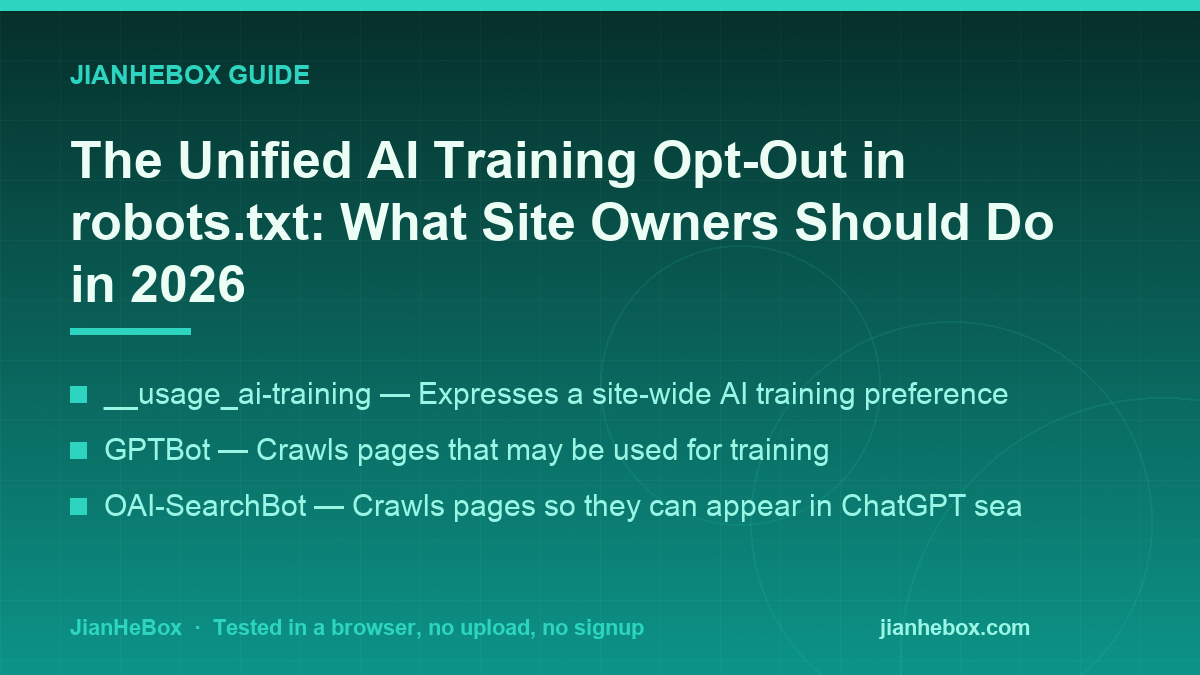
| GPTBot | Crawls pages that may be used for training | Relevant when evaluating exposure through OpenAI’s training path |
| OAI-SearchBot | Crawls pages so they can appear in ChatGPT search results | Do not confuse training collection with ChatGPT search inclusion |
| ChatGPT-User | Fetches content in response to a user request | Represents a user-triggered retrieval path rather than the GPTBot training path |
| Google-Extended | Controls Gemini model training and grounding | Can affect citations in Gemini Apps and Vertex AI, but not Google Search inclusion or ranking |
Which Site Types Should Opt Out and Which Should Not?
Choose based on business dependency, not on a generalized fear of AI. A training refusal is sensible when exposure to training is the primary concern and citation loss is acceptable. It is poor strategy when citations are a material source of discovery and the content is not being used to produce a competing answer engine.
| Site type or primary objective | Recommended choice | Reason |
|---|---|---|
| Publisher, documentation site, or service whose visibility depends on AI answers and citations | Do not add the training refusal by default | The potential Gemini grounding loss can outweigh an abstract preference against training |
| Reference library, dataset, or content archive published primarily as training material | Opt out | Refusing training directly matches the site’s purpose and protects the intended distribution model |
| Small portfolio, utility, or informational site with little reliance on AI referrals | Opting out is usually low risk | The expected citation downside is limited, while the training preference is clearly expressed |
| Copyright-sensitive content owner that still values AI-answer visibility | Use a carefully reviewed combined configuration | Declare the training refusal and Google-Extended separately rather than allowing Google’s fallback to decide both |
| Site with mixed goals across pages | Review each content path separately | Training, search inclusion, and citation value may differ between material intended for distribution and material intended for answers |
| Site that wants unrestricted discovery across AI systems | Do not use the token | Explicit permission avoids a directive whose interpretation may affect more than training |
JianHeBox follows the unrestricted option: it allows every AI crawler and deliberately does not set the training opt-out token. That is a site-specific policy, not a universal recommendation. Its usefulness as an example is that it makes the choice explicit rather than leaving the policy to a vendor fallback.
The Rollout Timeline
The announcement is a common standard with a phased implementation, not an instant global switch. Plan the policy now, but do not assume that every crawler is enforcing the token on the day you publish it.
| Company | Announced support | Timing |
|---|---|---|
| Will support the shared training signal | Planned for 2027; crawler documentation refers to early 2027 | |
| Microsoft | Will support the shared training signal | Beginning February 1, 2027 |
| OpenAI | Will support the shared training signal | Stated as “the next few months” |
| Anthropic | Will support the shared training signal | Support is already being built |
Because recognition is uneven, test the behavior you care about rather than assuming the directive is active everywhere. A token that appears in robots.txt may still be ignored by a crawler that has not implemented it. The voluntary and gradual nature also means that the safest policy is the one you can defend in business terms, even if enforcement arrives later.
If You Want to Refuse Training Without Losing Citations
For Google, the key is to avoid the automatic fallback by declaring Google-Extended separately. A configuration that explicitly states both preferences looks like this:
User-Agent: __usage_ai-training
Disallow: /

User-Agent: Google-Extended
Allow: /
The first group states the training refusal. The second states the Google-specific AI permission and prevents Google from simply treating the absent Google-Extended declaration as a broad block. This is the configuration to consider when Gemini grounding is commercially important.
Do not describe Google-Extended as a citation-only control. It also controls Gemini training, and the announcement does not provide a citation-only robots.txt switch. Google has only described planned behavior, and the token is still rolling out. Keep the two declarations separate, state the policy clearly, and monitor Google’s implementation rather than assuming that an explicit Google-Extended permission has no training consequence.
If refusing Gemini training is absolute and losing Gemini citations is acceptable, the simpler path is the training-refusal group without a separate Google-Extended permission. If preserving citations matters more, use the separate declaration and accept that Google-Extended is a bundled control. What you should not do is add only the unified refusal and call the result “training only.” Under Google’s announced interpretation, that is precisely what it may not be.
Common Pitfalls
- Treating the token as a no-crawl switch. It does not stop crawling or indexing. Judge it as a training preference, then account for Google’s separate grounding consequence.
- Assuming it is a deindexing tool. Google-Extended does not affect Google Search inclusion or ranking. The likely loss is citations in Gemini, not normal search visibility.
- Adding it because “protect my copyright” sounds responsible. The directive is not a substitute for deciding whether your distribution model depends on AI answers.
- Calling Google-Extended training-only. It controls Gemini model training and grounding in Gemini Apps and Vertex AI.
- Ignoring Google’s fallback. A training refusal without a separate Google-Extended declaration may be interpreted as a Google-Extended block.
- Conflating OpenAI’s crawlers. GPTBot, OAI-SearchBot, and ChatGPT-User have different roles and operate independently.
- Assuming universal enforcement. Support is voluntary, phased in during 2027, and not present across every crawler today.
- Expecting a commercial agreement. Anthropic’s proposal notes that Microsoft said the mechanism would not create any authorization or paid agreement.
Frequently Asked Questions
Will __usage_ai-training stop AI crawlers from visiting my website?
No. The token is not a crawl block. Its intended meaning is narrower: participating crawlers may use the signal to decide whether the content is acceptable for AI training. The announcement explicitly says that adding it does not stop crawling, and pages can still be fetched and indexed. That distinction matters because search visibility and AI training are separate concerns. A crawler can visit a page for discovery or indexing without using that copy to train a model. The complication is Google’s planned fallback to Google-Extended, which can also affect Gemini grounding; the token is still not a conventional robots.txt rule that removes the page from Google Search.
Will opting out of AI training hurt my rankings in Google Search?
No, not through the controls described in the announcement. Google-Extended does not affect Google Search inclusion or ranking. It controls two Gemini-related uses: model training and grounding, meaning citations or references in Gemini Apps and Vertex AI. Therefore, refusing training through __usage_ai-training, by itself, is not a deindexing action. However, Google’s planned interpretation can cause an indirect citation effect: if no separate Google-Extended declaration exists, the training refusal may be treated as a Google-Extended block. That can remove the site from Gemini answers without changing its normal Google Search presence. Evaluate the rule as an AI-citation decision, not as a traditional search ranking switch.
Should a site that wants Gemini citations use the unified training opt-out?
Usually no, not without a separate Google-Extended declaration. The unified token appears to offer a clean training-only signal, but Google plans to interpret a refusal as a Google-Extended block when Google-Extended has not been declared separately. Since Google-Extended controls both Gemini training and Gemini grounding, that fallback can cost you citations in Gemini Apps and Vertex AI. A site whose visibility depends on AI answers should therefore treat the rule as a visibility decision, not merely an intellectual-property preference. If Gemini citations are valuable but training refusal is still desired, use the separate groups shown earlier and review Google’s implementation as it rolls out. Do not assume that the unified token is free of side effects.
How are GPTBot, OAI-SearchBot, and ChatGPT-User different?
They serve three independent purposes. GPTBot crawls pages that may be used for training. OAI-SearchBot crawls pages so they can appear in ChatGPT search results. ChatGPT-User fetches content when a user question triggers retrieval. Treating them as interchangeable leads to bad policy decisions. Blocking GPTBot because you do not want training does not, by itself, remove your pages from ChatGPT search, and controlling the search crawler does not necessarily control the user-triggered fetcher. The unified __usage_ai-training token expresses a training preference rather than collapsing these roles into one switch. When reviewing robots.txt, identify which behavior you actually want to prevent and which AI visibility you want to retain.
Is the unified AI training token active everywhere now?
Not everywhere, and not yet across every major implementation on the same schedule. The mechanism is voluntary and is expected to take effect gradually during 2027. Microsoft plans to support it beginning February 1, 2027. Google plans support in 2027, with crawler documentation referring to early 2027. OpenAI said support would arrive in the next few months, while Anthropic had already begun building support. Until a crawler recognizes the token, adding the group does not constrain that crawler’s training behavior. This is another reason to document the policy deliberately: you are preparing a shared signal, not applying an instantly universal technical switch across the AI ecosystem.
Does refusing AI training create a licensing or payment agreement?
No. Anthropic’s proposal explicitly notes that Microsoft said this mechanism would not produce any authorization or paid agreement. The robots.txt token should be treated as a technical usage preference, not a commercial contract or a source of revenue. It communicates whether a site consents to AI training under participating systems, but it does not itself establish a license, payment arrangement, or pricing relationship with any vendor. That separation is useful when reviewing the policy: decide independently whether the operational benefits of refusing training outweigh the visibility consequences, especially Google’s Gemini grounding behavior, rather than assuming the directive has legal or financial consequences beyond its crawler interpretation.
More on this:Browser Desktop Subtitle
Data verified November 7, 2026. Pricing, quotas, and features are per official platform pages.