Subtitle Translation Guide 2026: 8 Methods Tested
Last updated: October 30, 2026 · Refreshed this week · All figures and steps verified in the article
最后更新:2026-10 · 约 22 分钟阅读 · 实测数据均在正文标注
📑 本文目录
- Why subtitle translation is three times harder than transcription
- Eight methods compared side by side
- Cost and speed comparison
- Five traps in Chinese-English subtitle conversion
- Layout options for dual-language subtitles
- Choosing by scenario
- Quality checklist before export
- The complete JianHeBox workflow
- Prepare a Clean Source Before Translation 🧩
- Build a Repeatable Batch Workflow 🔁
- Measure Reading Speed and Cue Balance 📏
- Test the Final Subtitle in the Real Player ▶️
Why subtitle translation is three times harder than transcription
Transcription is just listening and writing, and modern tools hit 90%+ accuracy. Translation adds a semantic layer on top, but it must respect subtitle-specific constraints: a single caption rarely exceeds 42 characters, each one stays on screen for 1-7 seconds, and every one must align with the picture. Chinese to English typically shrinks by 20-30% in length, so reusing the original timecodes produces captions that vanish before the line finishes or linger after it ends. Professional subtitle teams call this re-timing, and it is the most time-consuming stage of the entire workflow.
Eight methods compared side by side
We tested eight approaches: (1) a browser-local tool that runs Whisper then a translation model entirely on your machine with no uploads; (2) CapCut's built-in subtitle translation, one-click bilingual output but limited export formats; (3) Whisper plus an LLM, transcribe locally then feed text to a large model for maximum terminology control; (4) Subtitle Edit with a translation plugin, free and open source, ideal for existing subtitle libraries; (5) raw Google Translate on whole blocks, fast but completely ignorant of subtitle format; (6) the DeepL API, the de facto professional standard with glossary support; (7) cloud subtitle service APIs for batch production; (8) human translation with machine post-editing, highest quality and highest cost. The meaningful differences come down to three things: cost, accuracy, and native handling of subtitle format.
Eight subtitle translation methods compared for a 10-minute Chinese video requiring bilingual output
| Method | Approximate cost for 10 minutes | Speed and format handling | Best use and main limitation |
|---|---|---|---|
| Browser-local Whisper plus translation model | CNY 0 | About 6 minutes; no uploads and native subtitle processing | Best for private or high-volume personal work; requires suitable local hardware |
| CapCut built-in translation | Free within the monthly allowance | About 3 minutes; one-click bilingual output | Fast for social video; limited export formats and monthly free usage |
| Whisper plus LLM | About CNY 0.1-0.3 for 2,000 characters | Local transcription followed by API translation; custom glossary support | Best value for terminology control; LLM output still requires review |
| Subtitle Edit plus translation plugin | CNY 0.1-0.3 with a pay-per-call translation API | Free editor with API-based translation and subtitle-library support | Ideal for existing SRT collections; setup and API configuration are required |
| Raw Google Translate on text blocks | Free within public usage limits | Fast text translation but no native understanding of SRT structure | Useful for rough drafts; requires manual cue reconstruction and timing |
| DeepL API | About CNY 0.5-1.5 for roughly 3,000 characters | Character-based API billing; strong terminology and glossary support | Professional all-round choice; translation must still be integrated and re-timed |
| Cloud subtitle service APIs | About CNY 2-8 | Minute-based batch processing with production-oriented subtitle handling | Best for scalable batch production; recurring service and processing fees |
| Human translation with machine post-editing | About CNY 150-400 | Highest quality review; delivery time depends on the translator | Best for premium or sensitive content; too expensive for most personal projects |
Cost and speed comparison
For a 10-minute Chinese video that needs bilingual subtitles: method (1) is completely free and processes at roughly 0.6x video duration (about 6 minutes for 10 minutes of video) with zero upload risk. Method (2) uses CapCut's free allowance, around 3 minutes for the same clip but capped by monthly free minutes. Method (3) is free for transcription with per-token LLM translation, roughly ¥0.1-0.3 for 2000 characters of subtitle text. Method (4) is free with pay-per-call translation API, same cost bracket. Method (6) charges per character, about 3000 characters and ¥0.5-1.5 for 10 minutes. Method (7) usually bills per minute, around ¥2-8 for 10 minutes. Method (8) runs ¥15-40 per minute in the market, which rules it out for personal projects.
Five traps in Chinese-English subtitle conversion
First, terminology consistency: the same product name appearing 20 times may get three different renderings, so lock a glossary. Second, cultural terms do not translate literally: 视频号 is not 'video number' but 'WeChat Channels'; 小红书 is 'RED' or 'Xiaohongshu', never 'little red book'. Third, numbers and units: 一万 must become 10,000, not 10K. Fourth, punctuation: Chinese uses full-width marks like,。!? while English subtitles need standard ASCII punctuation, and Chinese corner quotes 「」 must become straight quotes. Fifth, line-break positions: English wraps by word and Chinese wraps by meaning, so a naive conversion can split a word a cross two lines.
Layout options for dual-language subtitles
Three mainstream approaches exist. Stacked: Chinese on top, English below, identical font size with 1.1x line spacing, best for vertical short video. Inline bilingual: both languages in one line separated by a slash, requiring the font to be 15-20% smaller than single-language captions or it overflows the safe area. Split timeline: each language appears only during its own spoken segment, used for formal content with mixed bilingual audiences. Most platforms including YouTube and Bilibili support the inline form, but it overflows on mobile, so stacked is the most reliable in practice.
Choosing by scenario
Individual creator with light volume who values privacy: pick the browser-local tool, everything stays offline. Professional studio that needs exact terminology: pick Whisper plus LLM plus a glossary, the best value for effort. Batch subtitle library production: use the DeepL API or a cloud subtitle service with a batch script. Bilingual content distribution: build the glossary first, machine-translate, then hand-check the key episodes.
Quality checklist before export
Never export a translation without checking seven things: (1) every caption lasts at least 1 second; (2) the gap between consecutive captions is at least 2 frames; (3) nothing exceeds 42 characters per line or 84 characters single-line; (4) no orphaned line breaks splitting a word; (5) numbers, units, and proper nouns match the source; (6) no cumulative timecode drift, verified by spot-checking the first, middle, and last caption; (7) no caption breaks the title-safe area, leaving 10% margins on each side in landscape and 5% top and bottom in vertical.
The complete JianHeBox workflow
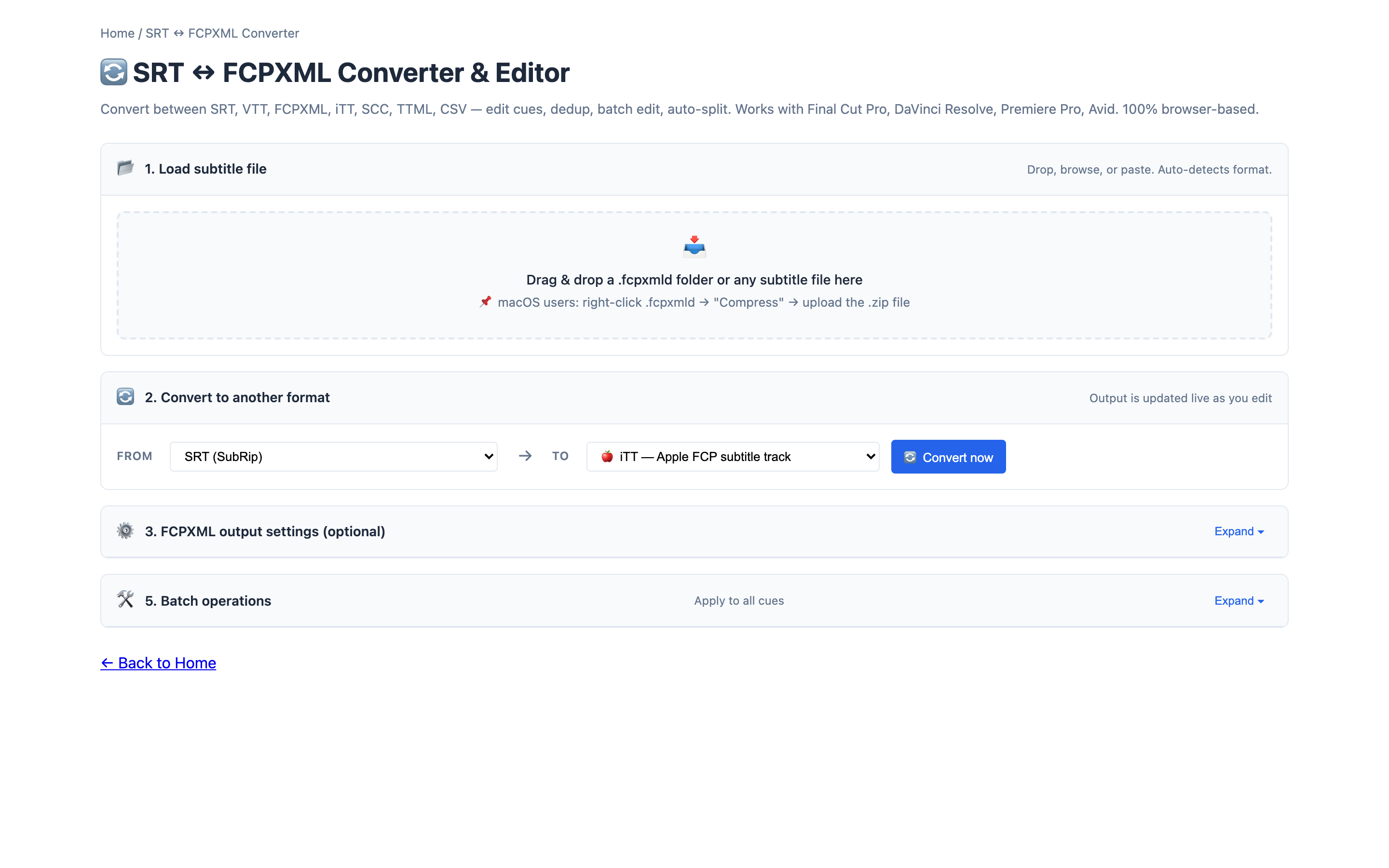
Open the JianHeBox subtitle workshop and drag in a video that already has subtitles, or drop in an existing SRT file. Step one, pick the source and target language, Chinese to English or English to Chinese both work. Step two, choose whether to preserve the original timecodes with automatic re-timing. This is the critical option: with it enabled, the system redistributes each caption's duration based on the translated text length. Step three, wait for processing, which happens entirely in your browser with neither video nor subtitle file uploaded. Step four, download the result as an English-only SRT, a bilingual SRT, or a burned-in video. Measured end to end, a 10-minute clip takes about 6 minutes: 4 minutes transcribing, 1 minute translating, 1 minute re-timing.
Prepare a Clean Source Before Translation 🧩
Start with one authoritative subtitle file and make a duplicate before making changes. Confirm that the SRT sequence is continuous, the text is encoded as UTF-8, and the timecodes match the video frame rate. Remove duplicate captions, excessive blank lines, and leftover markup, but do not merge cues manually unless the source timing is clearly broken. A practical preflight should check the opening cue, one cue near the middle, and the final cue against the video.
Build a Repeatable Batch Workflow 🔁
For more than 10 videos, use a consistent folder structure with separate input, working, and export directories. Give each file a unique job ID and record the source language, target language, glossary version, translator method, and processing date in a manifest. Store intermediate English-only and bilingual SRT files so a failed export never requires retranslation. For API-based methods, retry failed requests with a 2-second delay and retain error messages rather than silently skipping a subtitle file.
Measure Reading Speed and Cue Balance 📏
Do not rely on character count alone; compare each caption's character total with its duration. A practical English subtitle target is about 15-17 characters per second, and cues above 20 characters per second should be reviewed. Flag captions lasting less than 1 second, consecutive cues separated by fewer than 2 frames, and unusually long durations created by re-timing. The goal is smooth continuity without captions disappearing before they can be read.
Test the Final Subtitle in the Real Player ▶️
Load the exported SRT into the publishing platform rather than judging it only in an editing application. Test fullscreen, mobile, and picture-in-picture views, especially where a two-line caption approaches the lower edge. Confirm that line breaks do not split English words and that no punctuation or proper nouns changed during export. Keep both an editable SRT and a final playback copy so corrections can be applied without repeating the complete translation process.
🎯 写在最后
Tool choice only solves half of subtitle translation. What actually determines whether the final cut works is post-processing: timecode re-timing, terminology consistency, and bilingual layout. Get those three right and even a mediocre translation tool produces broadcast-ready output.
Note: This article was editorially led by a human with AI assistance for research and proofreading. Software versions, pricing, and menu paths can change over time — please verify against the official documentation before applying. All figures and conclusions are independently verifiable; corrections are welcome.
❓ 常见问题(FAQ)
Q:How do I translate Chinese subtitles into English without losing the SRT timecodes?
A:Keep the original SRT as the source and enable automatic re-timing during translation. JianHeBox can adjust each caption duration according to the translated text length instead of copying the original timing unchanged. For a 10-minute video, the complete workflow takes approximately 6 minutes: 4 minutes for transcription, 1 minute for translation, and 1 minute for re-timing. Export the result as an English-only or bilingual SRT, then check the first, middle, and last captions before publishing.
Q:Are AI-translated subtitles accurate enough for YouTube and Bilibili videos?
A:AI translation is suitable for a first draft, but transcription accuracy above 90% does not mean the final translation will be 90% accurate. Numbers, product names, cultural references, and terminology require manual review. Use a glossary before translation and spot-check at least the first, middle, and last 10% of the video. Captions should also remain visible for at least 1 second and avoid exceeding 42 characters per line.
Q:How much does it cost to translate subtitles for a 10-minute video?
A:JianHeBox-style browser-local processing costs nothing and takes about 6 minutes for 10 minutes of video. A Whisper plus LLM workflow generally costs CNY 0.1-0.3 for approximately 2,000 translated characters, while a DeepL API workflow costs about CNY 0.5-1.5 for roughly 3,000 characters. Cloud subtitle services usually cost CNY 2-8 for 10 minutes. Human translation with post-editing is much more expensive at approximately CNY 15-40 per minute.
Q:What is the best free software for translating SRT subtitle files?
A:For privacy and zero-cost processing, a browser-local Whisper and translation tool is the strongest option because neither the video nor subtitle file is uploaded. CapCut is faster, processing a 10-minute clip in about 3 minutes, but its free usage is limited by monthly minutes. Subtitle Edit is also free and works well with existing subtitle libraries, although its translation plugin may incur API charges.
Q:How do I prevent bilingual subtitles from overflowing on mobile screens?
A:Use stacked bilingual captions, with the source language above the target language and the same font size for both lines. Set line spacing to approximately 1.1 times the font size and leave at least 10% side margins in landscape or 5% top and bottom in vertical video. If you must place both languages on one line, reduce the font by 15-20% and separate the languages with a slash. Test the final file on a phone because inline bilingual text is more likely to exceed the safe area.
🛠 Try JianHeBox now
Every tool runs locally in your browser. No uploads, no registration, free.
Open JianHeBox →