Tencent WeVisOne-VL: One Open Model for OCR, Segmentation, Matting, and Detection
📌 Key Takeaways (TL;DR)
- Imagine an engineering team that receives four kinds of images through the same pipeline: scanned pages that need OCR, product photographs that need object detection, refer…
- WeVisOne-VL offers a different integration model. Built on Qwen3-VL and released in 2B and 4B parameter sizes, it produces target descriptions and spatial coordinates in on…
- The most immediately useful fact is not simply that the model is open. The 2B version is reported at only 4.88GB and runs on consumer GPUs. That makes local evaluation real…
The local-inference problem WeVisOne-VL addresses
Imagine an engineering team that receives four kinds of images through the same pipeline: scanned pages that need OCR, product photographs that need object detection, reference images that need instance or semantic segmentation, and foreground images that need matting. A conventional solution may route those images through several specialized models, each with its own preprocessing rules, output format, deployment configuration, and failure modes. The application layer then has to reconcile whatever those models return before it can display a result.
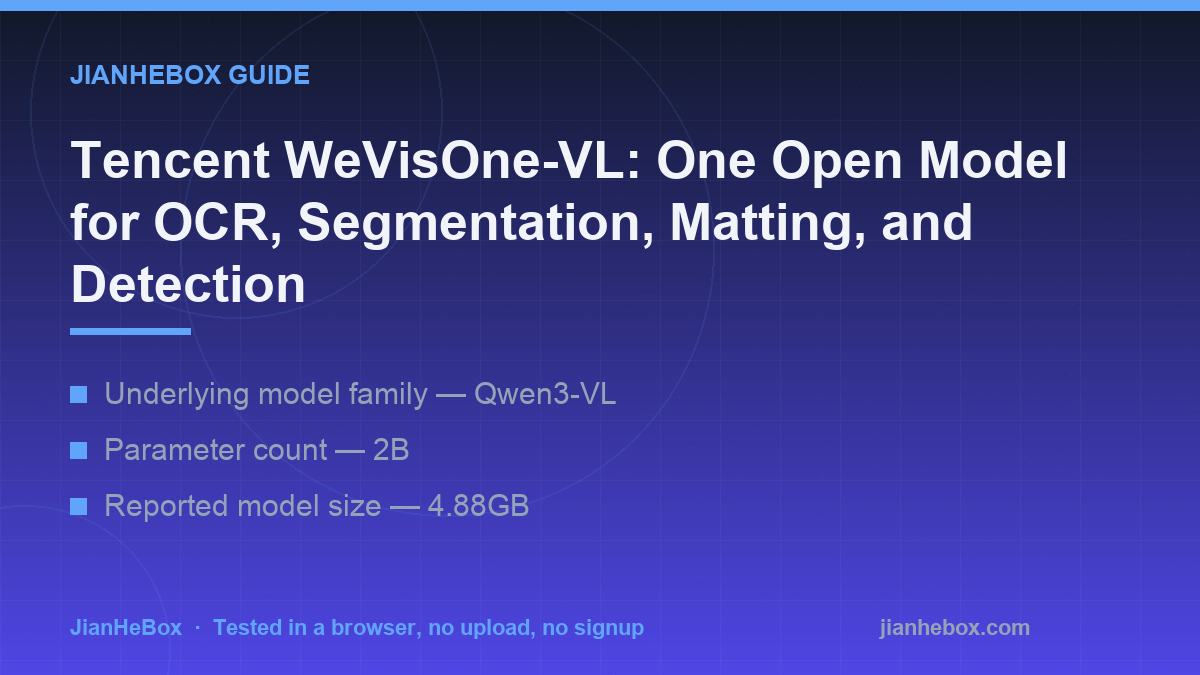
WeVisOne-VL offers a different integration model. Built on Qwen3-VL and released in 2B and 4B parameter sizes, it produces target descriptions and spatial coordinates in one autoregressive sequence rather than relying on separate output heads for object-level tasks. Tencent’s WeChat team open-sourced the model on November 4, 2026. Online demos for both sizes had already gone live on Hugging Face in October 2026, giving users a way to examine both variants before local deployment.
The most immediately useful fact is not simply that the model is open. The 2B version is reported at only 4.88GB and runs on consumer GPUs. That makes local evaluation realistic for teams that want to test a unified OCR, detection, and segmentation workflow without beginning with a remote-service dependency. The architecture is compelling, but the sizing decision still needs to be driven by task-level results: WeVisOne-VL already provides a clear counterexample to the assumption that the larger model must perform better on every visual task.
What Tencent released
One model, two parameter sizes
WeVisOne-VL is built on Qwen3-VL. Tencent released both a 2B model and a 4B model, creating a direct choice between a smaller local candidate and a larger alternative. The supplied release information does not provide a separate storage figure for the 4B version, so the two models should not be treated as having predictable, proportionally identical deployment footprints.
Both variants were available through Hugging Face demos in October 2026. Those demos are useful for initial screening, especially when deciding which image categories deserve deeper testing. They should not, however, replace a local benchmark on the hardware and images that matter to your application. A demo proves that a model can be exercised online; it does not establish the memory ceiling, latency, output consistency, or task accuracy of your own deployment.
Descriptions and coordinates share one autoregressive sequence
The defining design choice is straightforward: target descriptions and spatial coordinates are written into one autoregressive sequence. WeVisOne-VL does not use a separate output head for each object-level task. Instead of assembling several task-specific outputs through independent mechanisms, the model generates the relevant visual information as a sequence.
For an engineer, this reduces the conceptual diversity of the integration surface. There is one model family and one generative output path to inspect. That does not mean the result can be consumed without validation. The release summary does not define a mandatory JSON schema, coordinate convention, mask encoding, or parser. Teams should therefore capture raw generations, confirm their structure for every task, and build a task-specific validation layer rather than assuming an output format that the source material does not document.
There is also an important distinction between removing object-level output heads and removing all visual machinery. The matting benchmark explanation explicitly refers to a pixel decoder, showing that different tasks can still depend on task-relevant components. The unified sequence is the model’s central architectural idea, not a guarantee that every capability responds identically to changes in model size.
Seven task types, with five explicitly named
Tencent describes WeVisOne-VL as unifying seven visual task types. The supplied release material explicitly names object detection, OCR, instance segmentation, semantic segmentation, and matting, then refers to additional tasks without naming them. Those five named categories cover the four headline capabilities in the title, with both instance and semantic segmentation listed separately.
This distinction matters when building a validation plan. It is safe to create test sets for the five documented categories. It would be inappropriate to invent names for the remaining two task types or promise support for unspecified workflows. Before using an unnamed capability in production, obtain the relevant model documentation and verify its prompt, output, and expected behavior directly.
Local deployment: what is proven and what still needs measuring
The 2B model has a credible consumer-GPU path
The clearest deployment signal in the release information is the 2B model’s 4.88GB size and explicit ability to run on consumer GPUs. That makes it the sensible first model to validate if the objective is a local workflow. It also changes the discussion from “Can this class of model run locally?” to “Which tasks and quality targets does this particular local configuration meet?”
Do not treat 4.88GB as a guaranteed peak GPU-memory requirement. The source material does not specify runtime overhead, the supported serving stack, image handling details, or maximum deployment configuration. It also gives no equivalent consumer-GPU statement for the 4B model. The 2B model is therefore the only size for which local consumer deployment is explicitly established by the supplied facts.
A disciplined local pilot should record more than whether the model starts. Use representative inputs, retain the exact image and prompt, capture the complete generated sequence, and measure peak resource use and response time on the intended GPU. Repeat the process with the 4B model only if the target hardware can accommodate it. Comparing two complete local runs is more useful than comparing one local model with an online demo.
Keep the evaluation settings controlled
The reported evaluation used greedy decoding and allowed up to 1960 visual tokens per image. Those settings provide the only concrete baseline supplied for judging model output. Use greedy decoding for direct comparisons because introducing a different decoding strategy would change the experiment. Apply the same visual-token allowance to both sizes and to competing systems whenever possible.
The phrase “up to 1960” is important. It describes the evaluation limit; it is not evidence that every deployment will process the same number of tokens, nor does it establish a general resolution guarantee. Keep token allocation consistent, record it for each test, and avoid describing the evaluation limit as a broader capability that has not been documented.
Hands-on comparison: 2B versus 4B
The size comparison is not a simple “small versus large” tradeoff. The matting results demonstrate that the 2B model can outperform the 4B model on several metrics. A sensible selection process therefore starts with the smaller, locally feasible candidate and uses measured task performance—not parameter count—as the promotion criterion.
| Consideration | WeVisOne-VL 2B | WeVisOne-VL 4B | Practical interpretation |
|---|---|---|---|
| Underlying model family | Qwen3-VL | Qwen3-VL | The variants share the same stated architectural base. |
| Parameter count | 2B | 4B | Choose through workload testing rather than by size alone. |
| Reported model size | 4.88GB | Not provided in the supplied material | Do not invent a 4B storage figure by doubling the 2B number. |
| Consumer-GPU deployment | Explicitly stated | Not explicitly stated | The 2B model has the clearest documented local-deployment case. |
| Matting benchmark | Beats the 4B model on several metrics | Does not beat the 2B model on those metrics | For matting, the smaller model is the stronger starting candidate. |
| Online demo availability | Hugging Face demo from October 2026 | Hugging Face demo from October 2026 | Both sizes can be screened online before local testing. |
Why the smaller model can win at matting
Tencent’s explanation is unusually useful for model selection. The 2B model’s matting advantage comes from the task’s reliance on the pixel decoder and training data, not on backbone size. In other words, adding parameters to the backbone does not automatically improve a task whose outcome is driven by different components and data.
This is the central lesson from comparing the models. If a workflow is matting-heavy, the reported benchmark gives the 2B version a direct advantage before any custom evaluation begins. If the workflow depends on other named tasks, the 4B version may still deserve testing, but the supplied material does not claim that it wins those tasks. Treat the larger model as a candidate to evaluate, not as the default “more capable” option.
| Task or workload | Release evidence | Recommended starting point |
|---|---|---|
| Object detection | Named explicitly; descriptions and spatial coordinates use the unified sequence. | Test both sizes on the same images and prompts; start with 2B for local feasibility. |
| OCR | Named explicitly as a supported visual task. | Validate text and associated spatial output separately on representative documents. |
| Instance segmentation | Named explicitly as a supported visual task. | Use a task-specific scorecard and compare both sizes under identical decoding settings. |
| Semantic segmentation | Named explicitly as a supported visual task. | Do not infer its accuracy from detection results; benchmark it directly. |
| Matting | Named explicitly; the 2B model beats the 4B model on several reported metrics. | Begin with 2B unless local testing on your own images contradicts the benchmark direction. |
| Two additional task types | The release states seven tasks in total but does not name these two in the supplied material. | Confirm their documentation and behavior before including them in a production scope. |
A selection guide that respects the evidence
- Start with the 2B model for a local proof of concept. Its reported 4.88GB size and explicit consumer-GPU support provide the strongest deployment case. Verify that the model loads, that the output sequence can be parsed, and that the five named task categories meet your acceptance criteria.
- Create separate test sets for each task. OCR accuracy, detection quality, segmentation quality, and matting quality should not be collapsed into a single score. The matting result already demonstrates that ranking can change between tasks.
- Keep matting as an explicit 2B-versus-4B exception. The supplied benchmark says the 2B model wins on several matting metrics because the task depends on the pixel decoder and training data rather than backbone size.
- Promote the 4B model only after a measured win. The available information does not provide its exact storage footprint, consumer-GPU status, or task-by-task advantage. A larger parameter count is not a deployment plan.
- Lock decoding and visual-token settings. Use greedy decoding and the same allowance of up to 1960 visual tokens per image across candidates. Otherwise, a result change may reflect the experiment rather than the model size.
- Validate output structure before building downstream automation. The unified autoregressive sequence is documented, but a mandatory response schema is not. Write a parser only after observing and validating the actual output for each task.
Common pitfalls
- Assuming “one model” means “one level of accuracy.” WeVisOne-VL unifies seven task types under one model family, but unification does not establish equal performance. OCR, detection, segmentation, and matting still need separate acceptance tests.
- Selecting 4B because it is larger. The matting benchmark directly contradicts a simple size ranking. The 2B model wins on several matting metrics because that task relies on the pixel decoder and training data, not backbone size.
- Reading 4.88GB as a complete hardware requirement. The number establishes a compact local candidate and explicit consumer-GPU support. It does not provide a guaranteed peak-memory figure, a runtime requirement, or a supported serving configuration.
- Changing the experiment between model sizes. Greedy decoding and the allowance of up to 1960 visual tokens per image form the supplied evaluation baseline. Use the same settings for 2B and 4B or the comparison will be unreliable.
- Interpreting the token allowance as a resolution promise. The material says the evaluation allowed up to 1960 visual tokens per image. It does not state that this is the model’s universal input limit or that a particular image resolution will always be handled correctly.
- Naming unspecified tasks. Five categories are explicitly identified in the supplied release information, while two are only counted. Obtain documentation for those remaining capabilities instead of guessing from the word “more.”
- Assuming the raw sequence already has a production-ready schema. The architecture combines target descriptions and spatial coordinates, but the supplied material does not prescribe JSON, coordinate conventions, mask encoding, or error handling. Build against inspected output.
- Treating an online demo as a local performance result. The October 2026 Hugging Face demos are useful screening tools for both sizes. Final decisions still need local runs on the intended GPU and representative inputs.
- Assuming open source removes deployment work. The release establishes open availability, but the supplied information does not specify every runtime, packaging, license, or integration detail. Verify those items before promising a turnkey installation.
Frequently Asked Questions
Can the 2B WeVisOne-VL model run locally on a consumer GPU?
Yes. The supplied release information explicitly states that the 2B model is only 4.88GB and runs on consumer GPUs, making it the clearest candidate for a local proof of concept. That statement does not provide a guaranteed peak-memory figure or identify a specific runtime, so you should still validate the complete setup on your own hardware. Test model loading, image handling, sequence generation, and downstream parsing with representative inputs. The important distinction is that local consumer deployment is established for the 2B model, while no equivalent statement is provided for the 4B version.
Does the 4B model always outperform the 2B model?
No. Tencent reports that the 2B model beats the 4B model on several matting metrics. The stated reason is that matting relies on the pixel decoder and training data rather than backbone size. This result makes parameter count a poor proxy for task quality. The larger model should be evaluated for the particular workloads where it might help, but it should not be selected automatically as the default. Keep decoding and visual-token settings identical, compare both models on your own images, and promote 4B only when a recorded task-level improvement justifies its additional resource use.
Which seven task types does WeVisOne-VL support?
The release states that WeVisOne-VL unifies seven visual task types. The supplied material explicitly names object detection, OCR, instance segmentation, semantic segmentation, and matting, then refers to two additional types without identifying them. That means the total of seven is documented, but the complete named list is not available in the source information used here. Build your initial validation matrix around the five named categories and treat the other two as items to confirm from the model’s documentation. Do not infer names or behavior merely from the phrase “and more.”
How does removing separate output heads work?
WeVisOne-VL places target descriptions and spatial coordinates into one autoregressive sequence instead of using a separate output head for each object-level task. The practical implication is a unified generation path: the application does not need to treat every object-level task as a completely independent output mechanism. However, unified generation does not mean that every task produces the same kind of content or that the response already has a production-ready schema. The supplied material does not define JSON formatting, coordinate conventions, or mask encodings, so inspect and validate the raw sequence for each task before building parsers.
Is 4.88GB the full GPU-memory requirement for the 2B model?
The safe answer is no: 4.88GB is the reported model size, not a documented guarantee of peak GPU-memory consumption. The release does not specify the runtime, buffers, serving configuration, or other deployment overhead. It nevertheless establishes a strong practical advantage because the model is explicitly said to run on consumer GPUs. To obtain a real requirement, load the model on the target system, process representative images, and record peak hardware-memory use and latency. Report that measurement separately from the 4.88GB model-size figure so that readers can distinguish storage from runtime behavior.
How should I compare the online demos with a local deployment?
Use the online demos for screening and the local system for decisions. Both 2B and 4B demos were available on Hugging Face in October 2026, which makes them useful for checking whether the model produces plausible outputs across the five explicitly named task categories. A local run adds the hardware and runtime conditions that actually matter to your application. For controlled comparisons, use greedy decoding and the same allowance of up to 1960 visual tokens per image, record every prompt and input, and compare complete generated sequences. Do not treat the demo as a substitute for a local benchmark or assume its behavior will transfer unchanged.
Concrete recommendation
Start with WeVisOne-VL 2B on the intended consumer GPU. Its reported 4.88GB size makes local deployment the strongest documented option, and its matting benchmark already shows that smaller can be better. Build separate acceptance tests for OCR, object detection, instance segmentation, semantic segmentation, and matting; keep the two unnamed capabilities out of the initial production scope until their documentation is confirmed. Run every comparison with greedy decoding and the same visual-token allowance, then test the 4B model only if a recorded result justifies its additional resource demand.
For the first deployment, load the 2B model on the target consumer GPU, validate its raw output structure on representative images, and promote the 4B model only when task-level measurements show a benefit that outweighs its unspecified additional deployment cost.
More on this:Browser Desktop Subtitle
Data verified November 5, 2026. Pricing, quotas, and features are per official platform pages.